

Best Nootropics for Energy Without the Crash in 2026
Most advice about the best nootropics for energy starts with an ingredient list. That's the wrong starting point. A stimulant can look impressive on a label and still fail during a long shift because it arrives too late, peaks at the wrong moment, or creates a rebound that makes the next task harder.
The more useful question is how an ingredient reaches the body, when it reaches it, and what kind of energy it is meant to create. Caffeine and L-theanine have the strongest acute evidence for attention and alertness, while theacrine, creatine, adaptogens, and foundational nutrients serve different roles. Delivery format can change the subjective experience, but it doesn't automatically make an ingredient more effective.
| Candidate | What the evidence supports | Main limitation | Most relevant use |
|---|---|---|---|
| Caffeine plus L-theanine | Faster attention switching, alertness, and reduced distraction in controlled studies | Still a stimulant combination, so sensitivity matters | Focused daytime work |
| Theacrine | Acute changes in perceived energy and fatigue in a small human study | Human evidence remains limited | A caffeine alternative or complement |
| Creatine | Strong non-caffeine candidate for mental energy and brain fog according to independent reviews | Not an instant stimulant | Foundational support |
| Rhodiola, ashwagandha, and similar adaptogens | Stress and fatigue support may be relevant for demanding schedules | Effects and timing vary by ingredient | Resilience and recovery |
| Buccal or oral pouch delivery | Convenience and potentially faster onset, not proven higher total caffeine absorption | Absorption consistency and long-term adherence remain underexplored | Portable, time-sensitive use |
The practical framework is simple: match the molecule to the desired effect, match the format to the required onset, then distribute exposure across the schedule instead of forcing one large dose to carry the whole day.
Table of Contents
- Why Most Energy Nootropics Fail Before Lunch
- The Core Nootropic Categories for Sustained Energy
- Caffeine Stacks, Theacrine, and Adaptogens Compared
- Why Delivery Format Changes the Whole Experience
- Matching Nootropic Stacks to Your Real Schedule
- A Smarter Daily Protocol From Morning to Evening
- Dosing Safety and Tolerance Checklist Before You Start
Why Most Energy Nootropics Fail Before Lunch
Energy products often fail before lunch because users judge the ingredient while ignoring the route. An oral capsule has to dissolve, move through the stomach and intestine, enter circulation, and undergo metabolic processing before the user feels its full effect. That delay can be useful when a steady rise is wanted, but it's poorly suited to a task that starts immediately.
Caffeine also doesn't create energy in the same sense as food or sleep. It changes the perception of fatigue by antagonizing adenosine signaling. If a dose arrives after the body's most demanding period has already begun, the user may experience a late surge followed by an equally inconvenient decline.
Cortisol rhythms, adenosine accumulation, sleep debt, and glycogen availability all influence the background state into which a nootropic arrives. A product that feels smooth after adequate sleep may feel harsh during circadian disruption. The same dose can also feel weak after habitual exposure and excessive after a period of reduced caffeine use.
The timing problem behind the “crash”
A crash isn't always proof that a formula is defective. It can reflect a mismatch between onset, peak effect, meal timing, and accumulated fatigue. A beverage can arrive faster than a capsule, but rapid onset can also make the peak feel more abrupt. A slow-release formulation may feel less dramatic while providing a more useful plateau.
The caffeine and L-theanine evidence illustrates why composition and timing must be considered together. In a controlled study of 27 healthy volunteers, 50 mg caffeine plus 100 mg L-theanine improved attention-switching speed and accuracy at 60 minutes, while also reducing susceptibility to distraction at 60 and 90 minutes compared with caffeine alone. The findings support a targeted attention effect, not a claim of unlimited energy, and come from the published controlled trial.
Practical rule: If a product feels late, sharp, or oddly short-lived, changing the ingredient may be less useful than changing the timing and delivery format.
Three decisions solve more problems than a longer label:
- Choose the mechanism: Decide whether the target is wakefulness, attention control, stress tolerance, motivation, or longer-term energy support.
- Choose the route: Capsules suit predictable planning, while portable oral formats may suit tasks that begin without notice.
- Sequence the day: Use separate windows for activation, demanding work, afternoon maintenance, and recovery.
That approach also prevents the common mistake of treating every tired moment as a reason for another stimulant.
The Core Nootropic Categories for Sustained Energy
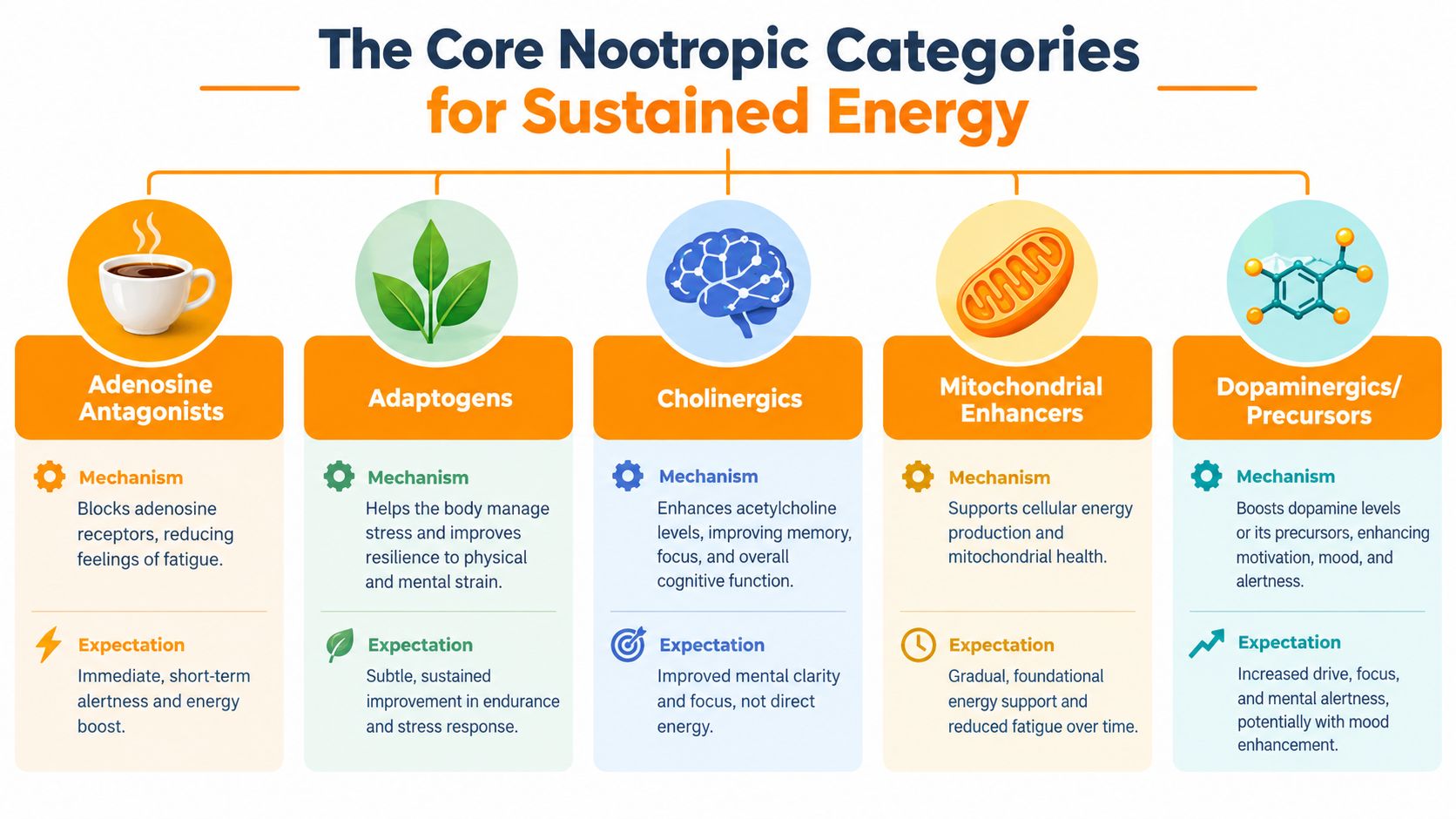
A buyer encounters several nootropic categories, but they don't all produce the same kind of energy. The first distinction is between subjective stimulation, cognitive throughput, and foundational support.
Fast alertness through adenosine antagonism
Caffeine is the clearest example. It reduces perceived fatigue through adenosine receptor antagonism, so the expected result is faster alertness rather than replenished physical reserves. Theacrine belongs near this category, but it has a smaller human evidence base and shouldn't be marketed as a proven replacement for every caffeine use case.
Theacrine's relevant human data came from a 200 mg dose, which produced a +8.6% change in subjective energy, compared with a -5.7% change on placebo, and a -6.7% change in fatigue, compared with +5.8% on placebo. The study also reported a concentration trend of +2.4% versus -1.3% over a seven-day observation period, as described in the human theacrine study. Those findings are interesting, but the study doesn't establish a complete long-shift solution.
Attention support and precursor logic
L-theanine isn't a direct energy stimulant. Its strongest relevance in this context comes from pairing it with caffeine, where controlled trials have examined attention switching, alertness, tiredness, and distraction. L-tyrosine is commonly positioned as a catecholamine precursor for demanding or stressful conditions, but the available brief doesn't provide a verified quantitative performance claim for it.
This category should set a realistic expectation: smoother task engagement or better attention control, not an unlimited supply of drive.
Cellular energy and mitochondrial support
Creatine, B vitamins, CoQ10, and related nutrients are often grouped around cellular energy production. They're conceptually different from caffeine because they support biological processes rather than masking fatigue. Independent 2026 coverage identifies creatine as the most evidence-backed non-caffeine option for brain fog and mental energy, but that conclusion doesn't make it an instant pre-task stimulant.
B vitamins deserve the same restraint. They're useful when dietary intake or status is inadequate, but a high-potency blend shouldn't be treated as automatically superior to standard dietary dosing.
Cholinergic and adaptogenic categories
Citicoline and Alpha-GPC are cholinergic options intended to support attention and memory. Their expected benefit is clearer mental processing, not a direct burst of physical energy.
Rhodiola, ashwagandha, ginseng, and cordyceps are usually framed as adaptogens or stress-resilience ingredients. They may fit a routine built around sustained strain, but their effects shouldn't be described as equivalent to immediate caffeine alertness. The useful question is whether the ingredient matches the fatigue pattern, not whether its marketing uses the word “energy.”
Caffeine Stacks, Theacrine, and Adaptogens Compared
The ingredient list matters less than the protocol around it. Onset, predictability, subjective intensity, and overlap between mechanisms determine whether a product supports a planned work block or just adds another stimulant peak. The table uses only dose information supplied in the brief. Where research does not establish a reliable onset or duration, the entry remains qualitative.
| Ingredient | Typical Dose | Onset | Duration | Crash Risk | Best Use |
|---|---|---|---|---|---|
| Caffeine plus L-theanine | 50 mg caffeine + 100 mg L-theanine in a controlled study | Acute, with performance effects assessed at 60 minutes | Acute attention support, with distraction findings at 60 and 90 minutes | Lower perceived harshness than caffeine alone for some users, but not eliminated | Focused work requiring attention control |
| L-theanine plus caffeine | 40 mg caffeine + 97 mg L-theanine in a controlled study | Acute | Acute alertness and task-switching support | Individual response varies | Moderate daytime stimulation |
| Theacrine | 200 mg in a human study | Acute subjective effects were observed | Short observation period, with concentration tracked over seven days | Not established | An alternative or complement to caffeine |
| Caffeine alone | Dose varies by product | Depends on route and formulation | Depends on dose, metabolism, and tolerance | More likely to feel abrupt when the peak is poorly timed | Simple wakefulness |
| L-tyrosine | No verified dose supplied for this article | Not established here | Not established here | Not established here | Stress-related cognitive demand, only with careful individual testing |
| B-complex formulas | Standard dietary doses are the conservative reference | Not an immediate stimulant | Foundational rather than acute | Low direct crash risk, but megadosing is inappropriate | Nutritional support |
| Rhodiola rosea | No verified dose supplied for this article | Not established here | Not established here | Not established here | Mental fatigue and stress resilience |
| Ashwagandha | No verified dose supplied for this article | Gradual rather than an immediate stimulant effect | Gradual | Not a classic stimulant crash profile | Perceived stress and recovery support |
| Cordyceps | No verified dose supplied for this article | Not established here | Not established here | Not established here | Physical-performance interest, with thin evidence for aerobic output |
The strongest practical case remains caffeine plus L-theanine, provided the goal is controlled attention rather than maximum stimulation. One controlled study examined 50 mg caffeine with 100 mg L-theanine. A later study tested 40 mg caffeine with 97 mg L-theanine and reported better task-switching accuracy, greater self-reported alertness, and lower tiredness. The published evidence on caffeine and L-theanine supports attention control and a smoother subjective experience, but it does not justify claiming that the combination improves every cognitive task.
Timing still changes the result. Taking the pair shortly before a predictable focus block may fit its acute effects better than using it reactively after fatigue has already disrupted work. The same ingredients can therefore feel useful in one schedule and poorly matched in another.
Theacrine belongs in a separate category. A human study reported changes in perceived energy, fatigue, and concentration, yet its evidence base is considerably smaller than caffeine's. The comparison of theacrine and caffeine frames the practical choice clearly: caffeine offers familiar acute alertness, while theacrine gives users a different adenosine-related option to evaluate. The available evidence does not establish theacrine as a universally smoother or longer-lasting replacement.
Adaptogens and foundational nutrients require an even narrower interpretation. B-complex formulas are better suited to nutritional support than an immediate energy lift. Rhodiola rosea and ashwagandha may fit mental fatigue, perceived stress, or recovery-focused routines, while cordyceps has limited support for aerobic output. Their value depends on the fatigue pattern and the schedule, not on their inclusion in a broad “energy” blend.
Stacking should therefore be selective. Caffeine and L-theanine have complementary subjective roles, whereas adding theacrine can create overlapping alertness rather than a clearly better response. A stimulant paired with a foundational nutrient may be more rational than combining several fast-acting stimulants, particularly for people who already consume coffee. The delivery format and timing protocol then determine whether that choice feels measured or excessive.
Why Delivery Format Changes the Whole Experience
A capsule, beverage, dissolvable strip, or buccal pouch may contain similar ingredients yet produce a different working experience. The relevant variables are time to effect, dose consistency, portability, and how easily the format encourages repeated use. In practice, timing and delivery can matter more than switching from one stimulant to another.
Capsules require gastrointestinal processing, so they suit a predictable task that can be planned in advance. They are easy to label and store, but delayed effects can lead users to take another dose too soon. Powders introduce a different consistency problem: the active amount depends on accurate measuring, and proprietary blends make comparisons harder.
Beverages offer convenience and a familiar ritual. Because they are consumed quickly, they can also encourage casual redosing. A strip or pouch may be easier to use discreetly during a shift, but that convenience removes the pause that often accompanies making another coffee.
| Format | Onset | Duration | Crash Risk | Best Use Case |
|---|---|---|---|---|
| Capsule | Slower and more dependent on digestion | Depends on ingredient and formulation | Timing errors can make the peak feel misplaced | Planned work blocks |
| Beverage | Often perceived as relatively quick | Depends on concentration and consumption pattern | Rapid intake may feel sharper | Situations where a drink is already part of the routine |
| Dissolvable strip | Designed for convenient, measured use | Depends on the active ingredient | Dose consistency may improve, but ingredient effects still govern | Portable, discreet pre-task use |
| Buccal or oral pouch | Potentially faster onset than a capsule | Depends on active ingredients and formulation | Faster onset doesn't prove lower crash risk | Shift work and unpredictable schedules |
What the evidence says about buccal delivery
A review of caffeine pouches concluded that buccal delivery offers “no clear advantage in the total amount of caffeine absorbed”, with the main distinction being onset speed. That separates a defensible convenience claim from an overstated bioavailability claim. The review of caffeine pouch delivery supports judging pouches by time-to-effect and adherence, rather than assuming they create stronger systemic exposure.
The route also leaves room for individual variation. Saliva, placement, formulation, dose, and user behavior can affect how consistently a pouch feels. A fast-acting format may suit a short focus block, while someone who dislikes rapid peaks may prefer a capsule or slower beverage routine.
The comparison of sublingual versus oral delivery adds useful context for interpreting route differences. The practical conclusion is narrow: format can alter the timing experience, yet it cannot compensate for an unsuitable ingredient, an excessive dose, or poor sleep. A better protocol therefore matches the route to the task, then leaves enough time to assess the response before repeating it.
Matching Nootropic Stacks to Your Real Schedule
The right stack changes with the work pattern. A nurse moving through an overnight shift has a different problem from a developer protecting a morning deep-work block, even if both describe the problem as low energy.
The shift worker
A shift worker needs a controlled late-day plateau rather than a dramatic opening spike. A cautious protocol could place slow-release caffeine before the demanding part of the shift, then use theacrine as a separate option only if the first exposure proves insufficient. Rhodiola may fit a stress-related fatigue pattern, but the evidence does not establish a guaranteed benefit across every occupation or shift.
The key is separation. If caffeine and theacrine arrive together, the user may not know which compound helped or which one caused unwanted stimulation.
The deep-work professional
A professional with a predictable focus session can use a measured buccal caffeine format before the session and test L-tyrosine separately on a different day. B-complex support belongs with normal nutrition, not as a reason to keep adding stimulant products.
A useful performance principle is to define the task before selecting the stack. Research on the highest level of performance is most useful when it reinforces that point: output depends on matching the intervention to the operating demand, not merely increasing intensity.
The gym and biohacker user
Training users often want energy, motivation, and physical output at once. Theacrine may be tested around training, while tyrosine or cordyceps can be evaluated as separate variables. Cordyceps deserves particular caution because the brief identifies the evidence for aerobic output as thin.
A clean experiment changes one element at a time. Otherwise, the user can't distinguish a stimulant effect from expectation, hydration, food timing, or the training session itself.
The former nicotine user
A former nicotine user may value the oral ritual as much as the chemical effect. A theacrine and tyrosine protocol can preserve a scheduled pause without recreating nicotine exposure, while caffeine use remains deliberately capped and tied to specific work windows.
The format may improve adherence because it's portable and discreet, but it shouldn't become an automatic every-hour behavior. The objective is to replace an uncontrolled cue with a defined performance routine.
A Smarter Daily Protocol From Morning to Evening
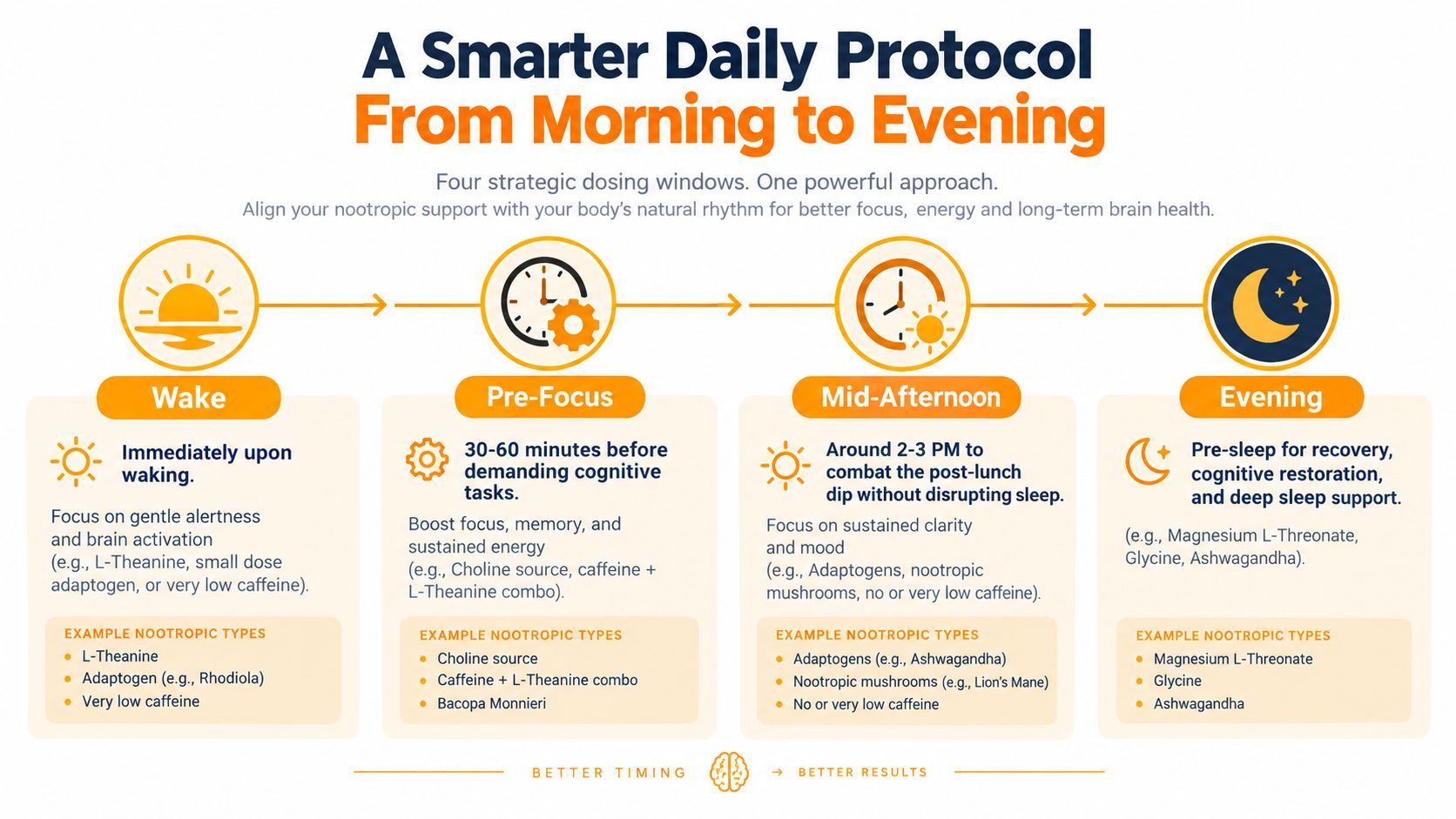
A single product rarely matches every point of a day. Wakefulness, focused work, afternoon fatigue, and evening recovery involve different demands, so a layered protocol usually makes more sense than repeating the same stimulant until bedtime.
Wake window
The first window should establish the baseline rather than chase a dramatic effect. Hydration, food, and normal dietary intake come before a complex stack. B vitamins may support nutritional adequacy, but they shouldn't be treated as an immediate stimulant or megadosed for a stronger feeling.
Users who are caffeine-sensitive may prefer no caffeine at wake-up. Those who tolerate it can reserve a modest dose for the period when alertness is needed.
Pre-focus window
Before demanding cognitive work, caffeine plus L-theanine has the clearest acute rationale in this article. Controlled studies examined combinations around 40 to 50 mg caffeine and 97 to 100 mg L-theanine, with improved attention-switching outcomes reported in the cited trials at specific assessment times. The exact dose should be adjusted to prior exposure and sensitivity, not copied blindly.
A buccal format may suit a task that begins soon, while a capsule may suit a longer planned lead-in. The point is to make the route match the start time.
Mid-afternoon window
The afternoon window shouldn't automatically duplicate the morning dose. A user may choose theacrine as a separate trial, an adaptogen for a stress-heavy schedule, or no stimulant at all. If the afternoon input repeatedly damages sleep, the protocol is failing even if it improves short-term output.
Theacrine's human evidence includes a 200 mg study dose, but that doesn't establish that every person should use that amount. The study supports interest, not a universal prescription.
Evening wind-down
The evening window removes stimulants and protects recovery. Magnesium glycinate and ashwagandha are often discussed in this context, but the brief doesn't provide verified quantitative sleep outcomes for either. Their role should therefore be framed as part of a wind-down routine, not as a guaranteed antidote to late stimulant use.
The best daily protocol is the one that leaves the next morning intact. A short-term lift that delays sleep can reduce the value of every later intervention.
Dosing Safety and Tolerance Checklist Before You Start
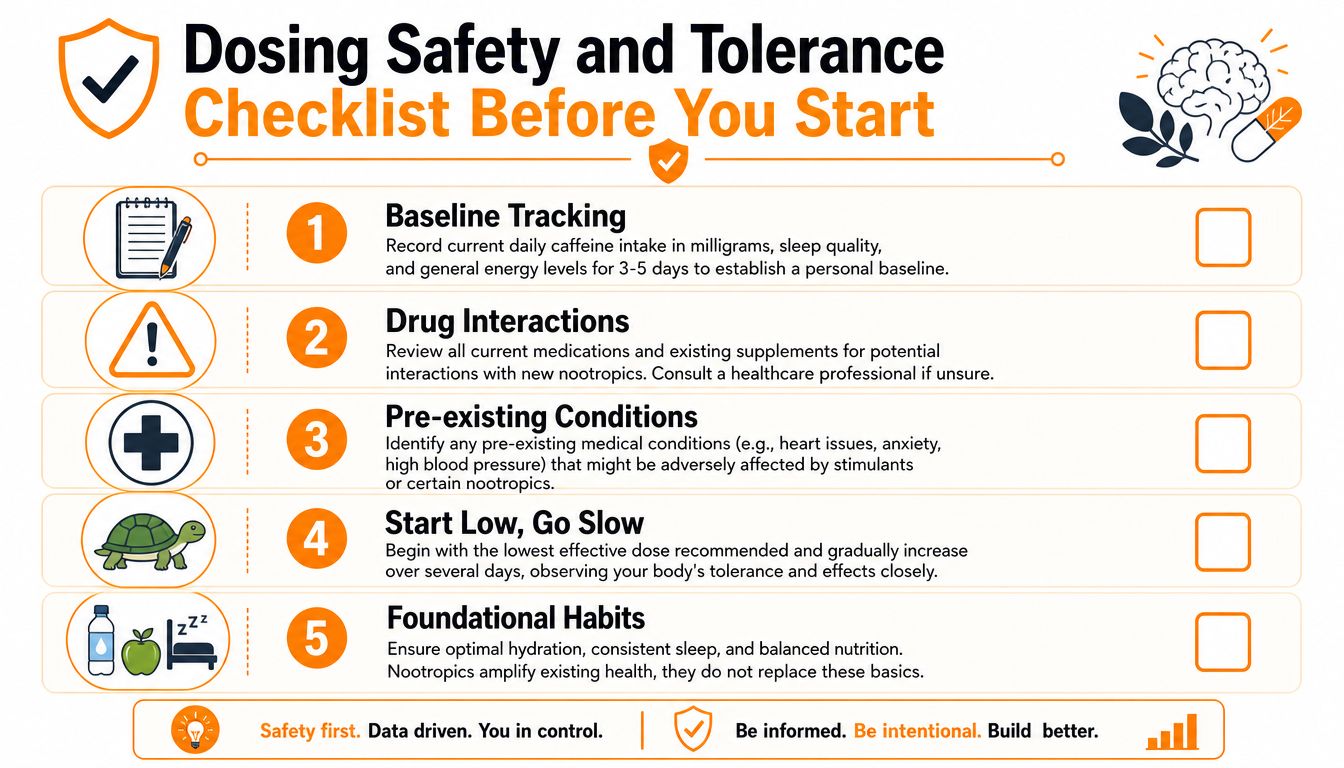
A new nootropic routine should begin with measurement, not enthusiasm. The baseline should include current daily caffeine intake in milligrams, sleep timing, perceived energy, and resting heart rate or HRV when those measures are already available. Medication use also matters because stimulant metabolism and interaction risk can vary.
The conservative ranges supplied for this article are 50 to 100 mg caffeine per dose, with a daily ceiling of 400 mg, 50 to 150 mg theacrine, 500 to 1,000 mg L-tyrosine away from protein-heavy meals, and B-complex products at standard dietary doses rather than megadoses. The caffeine ceiling and broader dose guidance should be checked against how much caffeine is too much, especially when coffee, tea, beverages, and supplements are combined.
Run the checklist before changing the routine
- Record the baseline: Track caffeine, sleep, energy, and any available heart-rate data before adding a new product.
- Review medications: Pregnant or nursing individuals, people taking SSRIs, MAOIs, or blood-pressure medication, and people with anxiety disorders should consult a clinician before using stimulant or adaptogenic products.
- Change one variable: Adding caffeine, theacrine, tyrosine, and an adaptogen at the same time makes both benefits and side effects difficult to identify.
- Test tolerance deliberately: A reduction in caffeine may be more practical than complete abstinence for some users. A two to four week washout window can be considered when tolerance or diminishing returns are suspected, but the exact approach should reflect the person's baseline use and medical context.
- Stop at red flags: Chest tightness, sustained resting heart rate above 100 bpm, panic-like anxiety, or sleep-onset latency consistently above 30 minutes warrant stopping the new routine and seeking appropriate medical advice.
The strongest conclusion is also the least marketable one. No stack can compensate for chronic sleep disruption, and no delivery format guarantees smooth energy. The best nootropics for energy are the ones that fit a specific task, arrive at a useful time, use transparent dosing, and leave the user capable of sleeping and performing again the next day.
Optimal Native offers nicotine-free oral pouches organized around morning energy, daytime flow, and evening relaxation, using formats designed for portable, time-anchored routines. Readers comparing delivery formats and timing protocols can visit Optimal Native to review the available system and decide whether a pouch-based approach fits their schedule.