

Best Nootropics for Focus: An Evidence-Based 2026 Guide
The most popular advice about the best nootropics for focus is also the least useful: pick one winning ingredient and take it every day. Focus isn't a single output, and a supplement that improves alertness may do little for distraction, task switching, or recovery. The strongest evidence points instead to task-specific fit, dose transparency, and timing.
The clearest example is the caffeine and L-theanine combination. A systematic review found repeated human research across attention, inhibitory control, mind-wandering, cognition, and mood, while randomized trials reported improvements in task-switching speed and accuracy and lower susceptibility to distraction after the combination was taken (systematic review of caffeine and L-theanine). That doesn't make it the universal winner. It makes it a strong option for a particular job, short-term selective attention with less subjective harshness than caffeine alone.
| Focus need | Most relevant ingredient profile | Evidence position | Main limitation |
|---|---|---|---|
| Immediate alertness | Caffeine | Strong acute attention evidence | Can feel overstimulating and may interfere with sleep |
| Switching and distraction control | Caffeine plus L-theanine | Strongest combination signal among common over-the-counter options | Effects are task-specific, not universal |
| Stimulant-free support | Citicoline or selected herbal options | More conditional and slower | Less reliable for immediate focus |
| Stress-related mental fatigue | Adaptogenic ingredients such as rhodiola | Indirect focus rationale | Doesn't act like an acute stimulant |
| Longer-term cognitive support | Bacopa and related options | Slow, conditional evidence | Not a next-hour solution |
Table of Contents
- Why There Is No Single Best Nootropic for Everyone
- What Focus Actually Means and How It Is Measured
- Comparing the Main Ingredient Classes for Focus
- How to Evaluate Any Focus Supplement Before You Buy
- Matching the Right Stack to Your Workday
- Building a Segmented Daily Focus and Recovery Protocol
- Choosing Clean Focus Products Without Getting Burned
Why There Is No Single Best Nootropic for Everyone
A universal ranking assumes that every user starts from the same baseline, performs the same task, and responds to stimulation in the same way. None of those assumptions holds. A person trying to stay vigilant during a night shift has a different problem from a programmer protecting a long block of uninterrupted work, and both differ from a caffeine-sensitive user trying to reduce mental fatigue without sacrificing sleep.
The same ingredient can solve different problems
Caffeine illustrates the problem better than any other common ingredient. It can increase alertness, but alertness isn't identical to concentration. A user may feel more awake while becoming more distractible, tense, or dependent on repeated dosing. Another user may get useful activation from the same compound, while a third notices little benefit and mainly experiences unwanted stimulation.
Clinical trials also report average effects. Those averages help establish whether an ingredient can work under defined conditions, but they don't promise the same response for every person. Sleep debt, baseline arousal, habitual caffeine use, task difficulty, and individual sensitivity can all change the practical result. Genetic differences in caffeine metabolism, including variation involving CYP1A2, are plausible contributors to response differences, but a consumer shouldn't treat a genetic label as a substitute for observing actual tolerance and sleep quality.
Practical rule: A focus ingredient should be judged against a defined task, not against a vague feeling of being “more productive.”
The evidence therefore supports a job-based framework. Caffeine may fit immediate alertness. Caffeine plus L-theanine may fit short-term switching and distraction control. A slower option may fit stress-related fatigue or a desire to avoid adding another stimulant. Racetams and newer combinations deserve a higher evidence threshold because mechanistic appeal isn't the same as replicated human focus data.
Why rankings hide useful distinctions
A list that places one ingredient first compresses onset, duration, tolerability, and task type into a single score. That format is convenient for search, but it can lead a night worker toward a product that disrupts post-shift sleep or lead a caffeine-sensitive professional toward a formula that feels productive only because it raises arousal.
The better question is narrower: What kind of focus is failing, when does it fail, and what cost is acceptable? The rest of the evaluation follows that question rather than forcing every ingredient into one winner-takes-all order.
What Focus Actually Means and How It Is Measured
“Focus” is a group of measurable abilities, not one outcome. Sustained attention means maintaining performance over time. Selective attention means prioritizing relevant information while filtering competing input. Task switching measures how efficiently the brain changes rules or goals. Distractibility captures interference from irrelevant information, while reaction-time tasks assess processing speed and vigilance.
Researchers therefore keep these outcomes separate. A compound may increase subjective alertness without improving accuracy, or improve a demanding switching task without changing simple reaction time. The caffeine and L-theanine literature is useful because it has examined attention switching, inhibitory control, memory distraction, and mood instead of relying on one broad self-report result.
| Focus domain | Common test | Primary pathways | Example ingredients studied |
|---|---|---|---|
| Sustained attention | Psychomotor Vigilance Task | Adenosine and arousal systems | Caffeine, citicoline |
| Selective attention | Visual attention and reaction-time tasks | Acetylcholine, dopamine, arousal | Caffeine plus L-theanine |
| Inhibitory control | Stroop and Go/No-Go tasks | Prefrontal control, dopamine, glutamate | Caffeine, L-theanine |
| Working memory | N-back tasks | Glutamate, acetylcholine, dopamine | Citicoline, racetams |
| Task switching | Switching and alternating-rule tasks | Prefrontal networks, attention control | Caffeine plus L-theanine |
| Distraction resistance | Memory interference tasks | Inhibitory control and selective attention | Caffeine plus L-theanine |
Why the pathway matters
Adenosine modulation helps explain caffeine's effect on wakefulness. Acetylcholine participates in attention and memory processing, dopamine contributes to motivation and goal-directed behavior, and glutamate supports learning and working-memory networks. These systems overlap without being interchangeable. A product aimed at “focus” should therefore be judged against the outcome it plausibly affects.
This distinction also limits claims based on adjacent categories. Discussions of the cognitive benefits of terpenes can help frame emerging ingredient hypotheses, but mechanistic interest does not provide the same support as randomized human task evidence for caffeine and L-theanine.
The practical conclusion is straightforward. Better reaction time does not automatically mean better deep work, and lower perceived stress does not automatically mean stronger attention. The label, study design, dose, timing, and intended work pattern must point to the same job. That task-specific fit is more informative than assigning every ingredient a single overall rank.
Comparing the Main Ingredient Classes for Focus
Ingredient classes differ less by a universal potency hierarchy than by the work problem they address. Acute stimulant combinations have the clearest immediate signal. Slower herbal products may fit stress, fatigue, or longer-term support, while racetams and methylxanthines remain harder to place because plausible mechanisms do not equal consistent results in healthy users.
| Ingredient class | Evidence strength | Typical onset | Duration | Main drawback |
|---|---|---|---|---|
| Caffeine plus L-theanine | Strong acute human evidence | Short term | Short term | Stimulation can still affect sensitive users |
| Theacrine and other methylxanthines | More limited for focus-specific outcomes | Acute | Variable | Less established human focus profile |
| Racetams | Mixed and less conclusive for healthy-user focus | Variable | Variable | Marketing often outruns direct evidence |
| Adaptogens such as rhodiola and ashwagandha | Conditional, often indirect | Gradual or context-dependent | Variable | Better suited to stress or fatigue than instant focus |
| Bacopa and other herbal options | Slower, conditional human evidence | Requires consistent use | Longer-term support | Poor fit for urgent work |
The strongest acute option
Caffeine plus L-theanine has the clearest case for short, demanding work. Acute randomized studies tested combinations including 97 mg L-theanine with 40 mg caffeine and 100 mg L-theanine with 50 mg caffeine. Reported benefits included task-switching accuracy, alertness, speed, and distraction-related outcomes (randomized trial evidence).
A 2025 double-blind crossover study also reported better selective visual attention accuracy and speed after a high-dose combination in sleep-deprived young adults. The direct study record is more appropriate here than repeating a review link.
That pattern supports demanding work blocks and shift-work alertness more convincingly than broad “energy” claims. The combination is still a poor universal answer for people who are sensitive to stimulation, especially if timing interferes with sleep. Fit depends on the task and the user's response, not only on the ingredient list.
L-theanine alone has a smaller, more conditional effect. A meta-analysis of five randomized trials in 148 healthy adults found a mean improvement of about 15.2 milliseconds in recognition visual reaction time, while simple reaction time and Stroop outcomes were not significant (L-theanine meta-analysis).
Where the other classes fit
Theacrine and other methylxanthines may suit users seeking stimulation without following a conventional caffeine pattern, but focus-specific human evidence remains less established. Racetams such as piracetam and aniracetam have extensive discussion around learning and membrane signaling. Those mechanisms do not establish a dependable focus benefit in healthy adults.
Adaptogens work more indirectly. Rhodiola may fit stress-related mental fatigue, while ashwagandha is generally discussed in relation to stress and recovery rather than immediate selective attention. Bacopa illustrates the importance of timing. It is a poor choice for judging after one demanding afternoon, because its role is associated with consistent use and longer-term support. Recent review coverage separates slower ingredients such as bacopa from acute caffeine-based options, making onset part of product fit (recent review of L-theanine and focus-related evidence).
Choline donors occupy a middle position. Citicoline may suit a stimulant-free approach, but it is not a universal top pick. The choice between citicoline and alpha-GPC depends on formulation, tolerance, and the quality of the product's human data. This comparison of alpha-GPC and CDP-choline helps clarify that choice without treating either ingredient as an instant replacement for the better-established acute combination.
How to Evaluate Any Focus Supplement Before You Buy
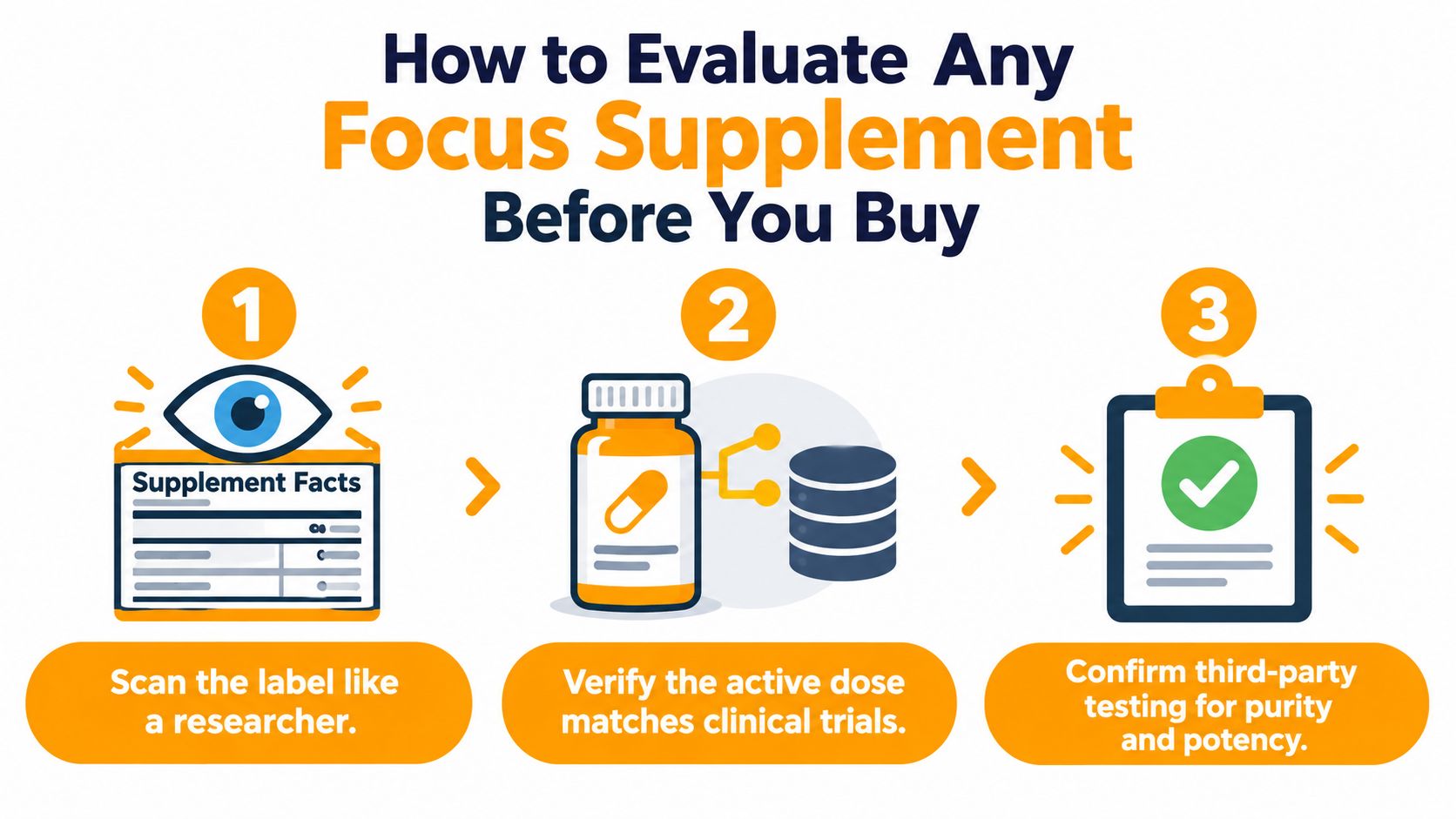
A supplement label should answer three questions quickly: what is included, how much is included, and whether the finished product has been tested. If a formula hides every active inside a proprietary blend, the consumer can't compare it with clinical research or determine whether a meaningful dose is present.
Read the panel like a trial protocol
Start with the active ingredients, not the front-label promise. A clinically familiar ingredient name means little if the dose is undisclosed or far below the amount used in research. The same applies to standardized botanicals, where the extract identity and marker compounds can matter as much as the headline plant name.
Look for:
- Individual amounts: Each active should have its own declared dose.
- Form identity: Branded forms may have published data, but a trademark alone isn't proof of efficacy.
- No filler language: Terms such as “neuro-matrix” or “brain complex” don't replace ingredient disclosure.
- Testing evidence: Lot numbers and accessible certificates of analysis provide more useful information than vague purity claims.
Separate certification from decoration
Third-party programs such as NSF Certified for Sport, USP, and Informed Sport can provide meaningful quality signals when the certification applies to the specific product. A badge without a verifiable listing is weaker evidence. Independent testing platforms such as Labdoor or ConsumerLab may add useful scrutiny, although consumers should still check what was tested and whether the result applies to the current lot.
A short buying routine works better than a long ingredient checklist:
- Match the dose: Compare the label with human trial doses, not influencer recommendations.
- Verify the batch: Look for a lot number and a certificate of analysis tied to the product.
- Check the claims: Be skeptical of “instant genius,” “limbic system reset,” and other neuroscience-sounding phrases.
- Consider the underlying issue: Persistent attention problems may warrant professional assessment. Resources covering non-medication ADHD approaches for adults can provide broader context beyond supplement shopping.
A credible product won't promise to replace sleep, medical care, or a diagnosis. It will make a narrower claim, disclose the active amounts, and explain when a user should reasonably evaluate the result.
Matching the Right Stack to Your Workday
A workday changes the answer. Consider three users with the same complaint, “focus is poor,” but different constraints.
The night-shift professional needs vigilance during the biologically difficult early-morning hours and still needs to sleep after the shift. A caffeine and L-theanine combination may fit the shift-start window, while adding more stimulants later can create a recovery problem. The evidence supports the combination for attention switching and alertness, but it doesn't justify treating every shift as permission for escalating doses. Any stimulant plan should account for medications, cardiovascular conditions, anxiety, pregnancy, and individual sleep response.
The deep-work professional has a different target: fewer task switches and better resistance to digital distraction. Citicoline or alpha-GPC may fit a stimulant-free experiment, but the evidence doesn't support presenting either as a guaranteed productivity enhancer. Racetams are even more uncertain for this use case. A thoughtful protocol tests one variable at a time rather than stacking several under-researched compounds and attributing every good or bad day to the last capsule.
The caffeine-sensitive user should begin with the least disruptive option. L-theanine alone may be reasonable for a calm routine, while rhodiola or bacopa may suit someone whose focus loss tracks stress or longer-term fatigue. Those choices are slower and less direct than caffeine-based stacks, so expectations need to match the evidence.
| Persona | Primary stack | First dose timing | Expected duration |
|---|---|---|---|
| Night-shift professional | Caffeine plus L-theanine, with sleep protection as the priority | Near the start of the shift | Acute attention window, depending on sensitivity |
| Deep-work professional | Citicoline or alpha-GPC, with optional experimental additions treated cautiously | Before the planned work block | Gradual for choline donors, variable for racetams |
| Caffeine-sensitive user | L-theanine alone or a slower adaptogenic or herbal option | Earlier in the day for products with gradual effects | Variable, often less immediate |
The decision rule
If the task requires immediate alertness, the caffeine and L-theanine evidence is the most defensible starting point. If the task requires a stimulant-free routine, citicoline is more logically aligned than taking a lower dose of a stimulant that still disrupts sleep. If the main problem is stress-related fatigue, rhodiola may be a better conceptual match than a stronger stimulant.
For readers comparing broader productivity combinations, this guide to nootropic stacks for productivity is most useful when treated as a framework for timing and ingredient roles, not as proof that a large stack works better than a simple one.
Building a Segmented Daily Focus and Recovery Protocol
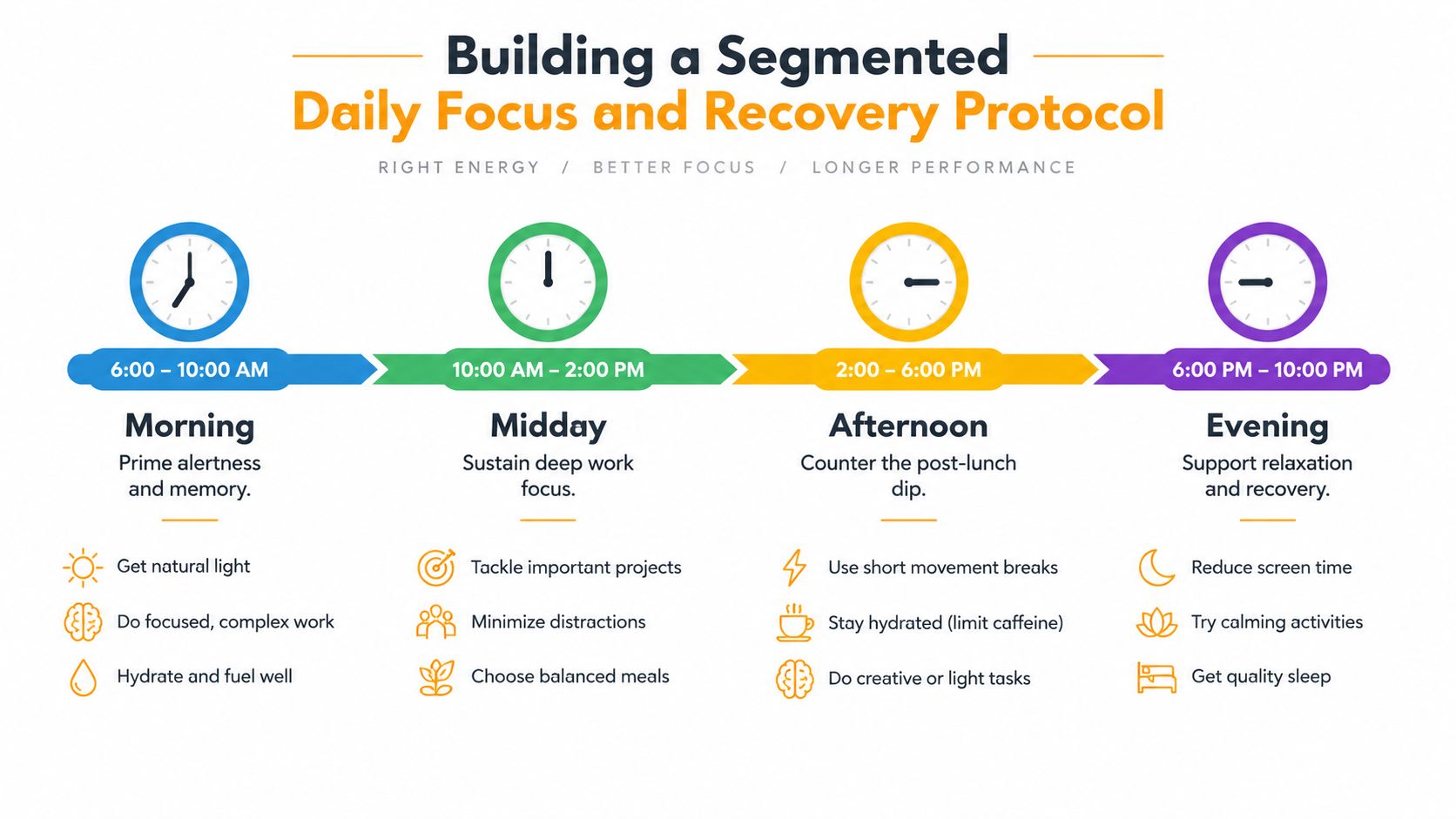
A single all-day formula asks one product to create alertness, preserve concentration, manage an afternoon dip, and support nighttime recovery. Those goals can conflict. A segmented protocol is more rational because it assigns different inputs to different biological and work demands.
Morning activation
The morning segment should establish alertness without spending the entire day's stimulation budget immediately. Caffeine plus L-theanine has the strongest acute evidence for attention switching, while sunlight, food, hydration, and a stable routine address non-supplement factors that influence perceived focus.
The important design choice is restraint. A larger early dose may feel productive, but a user who needs sleep later can turn morning activation into nighttime arousal. Normal sleepers often benefit from avoiding late stimulant exposure, although the exact cutoff depends on sensitivity and schedule.
The main work window
The peak work segment should reduce friction rather than chase a stronger sensation. A choline donor may be tested here as a stimulant-free option, while racetams should remain an experimental category because the human focus evidence is less settled. The work environment matters just as much as the stack: notifications, open chat windows, and uncontrolled task switching can overwhelm a modest cognitive benefit.
Afternoon adjustment
The afternoon segment should answer a diagnostic question: is the dip caused by sleep debt, a heavy meal, monotony, or a genuine need for more alertness? A short walk, water, and a smaller stimulant exposure may be more sensible than automatically adding another complex blend. Theacrine can be considered as an emerging methylxanthine option, but its focus profile doesn't have the same support as the caffeine and L-theanine combination.
Recovery rule: If an afternoon focus aid makes the evening harder, it may have improved the work block while weakening the next day.
Evening recovery
Evening is not another performance window. It is the period in which the user protects sleep quality and avoids turning fatigue into a permanent stimulant cycle. Magnesium, relaxation practices, reduced screen intensity, and a consistent wind-down can support that goal, but no supplement should be used to conceal a persistent sleep problem.
A practical swap system keeps the protocol honest:
- If morning stimulation causes tension, reduce stimulation before adding another calming ingredient.
- If the afternoon dip follows poor sleep, prioritize recovery rather than escalating the stack.
- If a slower product produces no meaningful change after a consistent trial, stop it instead of accumulating more products.
- If focus improves but sleep worsens, the protocol has failed its broader purpose.
The segmented model doesn't promise perfect concentration. It prevents the common mistake of treating every hour as if it requires the same neurochemical input.
Choosing Clean Focus Products Without Getting Burned
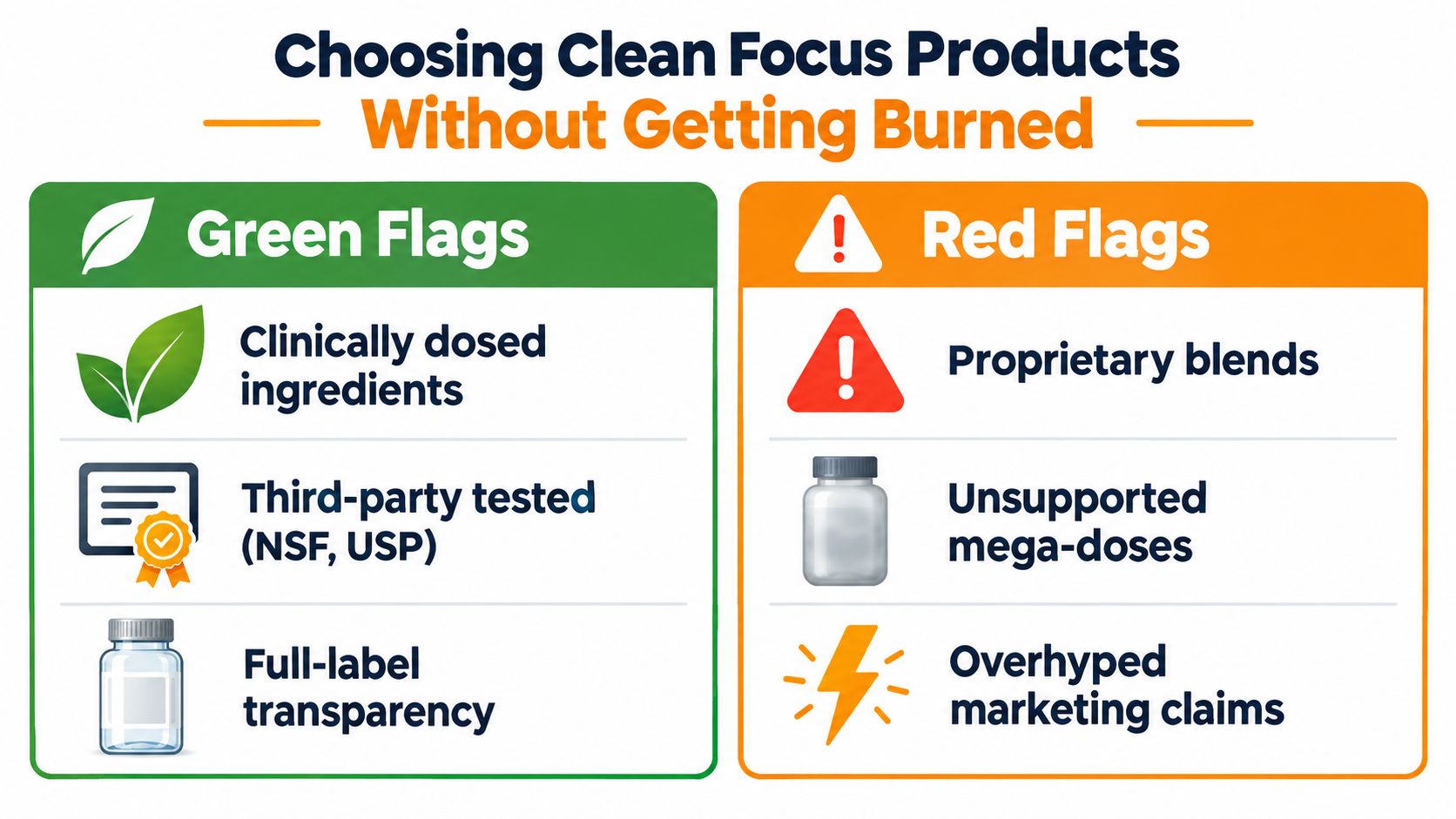
A clean focus product should make verification easy. The label needs to disclose every active dose, identify standardized or branded forms where relevant, and avoid hiding stimulants inside a blend that prevents total intake from being calculated.
Green flags and red flags
Green flags include clear serving instructions, lot identification, certificates of analysis, and testing through recognized programs such as NSF, USP, or Informed Sport. A brand that publishes allergen and heavy-metal information gives the buyer more useful evidence than one that relies on “advanced neuroscience” language.
Red flags deserve equal attention:
- Proprietary blends: They make dose comparison impossible.
- Stacked stimulant sources: Multiple forms of caffeine can raise total stimulation without making that fact obvious.
- Unsupported mega-doses: More ingredient isn't automatically more effective.
- Artificial urgency: “Limitless focus” and “FDA approved” claims are warning signs in a supplement context.
- Decorative complexity: Cheap fillers, artificial dyes, and high-dose B-vitamin additions can create an impressive panel without solving the relevant focus problem.
A five-minute verification routine
First, cross-reference each active with published human dose ranges. Next, check whether the product uses a defined extract or a generic powder, and whether the manufacturer provides a certificate tied to a real lot. Finally, inspect the marketing language for promises that exceed the measured outcome.
Delivery format can affect convenience, but it doesn't replace clinical evidence. For readers evaluating pouch-based routines, this guide to clean energy supplements provides a useful comparison point for thinking about ingredients, timing, and stimulant load.
Optimal Native offers nicotine-free oral pouches organized around morning activation, daytime focus, and evening wind-down, with formulations that include ingredients such as caffeine, theacrine, L-theanine, and evening-support compounds. That format may suit users who value portability, but the same standards still apply: verify the active doses, testing documentation, and compatibility with the user's sleep and medication profile.
The best nootropic isn't the loudest product on a marketplace page. It's the one with verifiable dosing, honest claims, a tolerable onset, and a protocol matched to the actual workday.
Readers can compare timing-focused, nicotine-free energy and focus options at Optimal Native, including daytime pouches designed for portable use and an evening formula intended for wind-down routines. The next step is to match the product's disclosed ingredients and timing to the specific focus problem, then evaluate the result without sacrificing sleep.