

Best Sleep Support Supplements for Every Lifestyle
After a 12-hour shift, a demanding presentation, or a late training session, the body may feel exhausted while the brain remains switched on. The bedroom is dark, the phone is finally face down, and sleep still doesn't arrive. A supplement can sometimes support that transition, but the right choice depends on why sleep is difficult, when the person needs to sleep, and how quickly the ingredient should act.
The best sleep support supplements aren't interchangeable. Melatonin can help coordinate circadian timing, while calming ingredients may support a quieter mental state. Delivery format also matters, especially for people who work nights, travel across schedules, or dislike swallowing pills. The practical approach is to identify the sleep problem first, then match the ingredient, dose, timing, and format to that problem.
Table of Contents
- Introduction to Sleep Support Supplements
- Understanding Supplement Fundamentals
- Ingredient Profiles and Dosing Guidelines
- Timing Strategies and Delivery Format Comparison
- Safety Considerations and Interactions
- Selecting Supplements for Your Lifestyle
- Nightly Routine Checklist for Optimal Sleep
Introduction to Sleep Support Supplements
Which sleep problem are you trying to solve? The answer may differ for a paramedic sleeping in daylight, a founder whose thoughts remain fixed on unfinished decisions, or an athlete who feels physically tired after a late workout but stays mentally alert. “Insomnia” describes the experience, not always the cause.
A circadian shifter may suit someone whose biological night conflicts with the time available for sleep. Another person may need a gentler wind-down routine that lowers stimulation without causing heavy next-day drowsiness. Repeated waking calls for a wider review of the sleep environment, alcohol intake, medication schedule, and possible health issues before adding another supplement.
Melatonin shows why dose and timing should be considered together. A 2024 systematic review reported that taking melatonin about three hours before the desired bedtime, at 2 to 4 mg per day, shifted sleep onset more effectively than taking 2 mg 30 minutes before bed (systematic review of melatonin timing and sleep promotion). This does not establish one schedule for everyone. It shows that the same ingredient can serve different purposes depending on when it is taken.
Practical rule: A supplement should answer a specific sleep problem, not simply add more ingredients to a nightly stack.
Sleep support is easier to choose when treated like schedule design. The approach separates circadian timing from relaxation, then compares formats such as capsules, liquids, and pouches according to convenience and intended speed. A shift worker may prioritize schedule alignment, a high-output professional may need a predictable wind-down, and a biohacker may care about precise timing and dose tracking. Long-term uncertainty, medication considerations, and a repeatable checklist also belong in the decision, because a product works best when it fits a habit that can be maintained.
Understanding Supplement Fundamentals
Sleep depends on two systems working together. The circadian rhythm acts like an internal clock, while sleep pressure builds during waking hours and makes rest increasingly likely. Light exposure, work timing, stress, food, and physical activity can all influence how those systems line up.
Melatonin primarily belongs to the timing system. It functions less like a blunt sedative and more like a message that tells the body, “The biological night is approaching.” This distinction matters for a nurse sleeping after a night shift. The challenge may not be a lack of exhaustion, but a clock that still interprets bright morning light as daytime.
A useful analogy is a theater dimmer switch. Circadian support gradually lowers the lights and helps the audience prepare for the show to end. A strongly sedating formula tries to darken the room quickly. Both approaches may feel relevant, but they solve different problems.
Circadian support or direct calming
A person who can fall asleep easily on vacation but struggles after rotating shifts may need help with schedule alignment. A person whose body is ready for bed but whose thoughts keep replaying emails may be looking for mental decompression. A person who wakes repeatedly needs a different assessment again, because immediate-release products may not match a sleep-maintenance problem.
The global market reflects how familiar these products have become. One industry estimate valued the sleep aid supplement market at US$6.8 billion in 2023 and projects US$11.8 billion by 2034, at a 5.1% CAGR (Future Market Insights sleep supplement market forecast). That commercial growth doesn't prove that every formula works, but it does show why consumers need a method for separating a useful formulation from a crowded label.
Before choosing a product, the sleeper should ask:
- What is the obstacle? Trouble falling asleep, waking during the night, or sleeping at the wrong biological time?
- What is the schedule? A stable bedtime allows a different plan from a rotating roster.
- What is the desired experience? A gentle transition may be preferable to strong sedation.
- What happens the next day? Any morning grogginess, dizziness, or impaired alertness is important feedback.
Ingredient Profiles and Dosing Guidelines
A formula can sound scientific while offering little practical guidance. Read the label like a tool kit: identify the job of each ingredient, check the stated amount, then ask whether that ingredient fits the person using it.
Melatonin
Melatonin is highly dependent on timing. Earlier administration, about three hours before the desired bedtime, produced better sleep-onset shifting in the cited review than taking 2 mg only 30 minutes before bed. The review used 2 to 4 mg per day. Conventional slow-release products may follow another schedule, so the label and clinician guidance still matter.
The best fit is usually a sleep window that does not match the person's biological schedule, such as after travel, during unusual work hours, or when bedtime has gradually drifted. A higher dose is not automatically better. Evaluate melatonin by sleep timing and next-day function, rather than by how heavily sedated it feels.
For a shift worker, the target is often schedule alignment. A biohacker may instead care about precise timing and a predictable response. A high-output professional should pay close attention to morning alertness, because a supplement that makes bedtime easier but leaves mental fog can undermine the next day.
L-theanine
L-theanine is commonly included for a calmer transition into sleep, not as a direct circadian signal. It may suit someone whose body feels tired but whose mind remains active during the wind-down period. Evidence and product quality vary, so the label should state the amount clearly rather than conceal it in a proprietary blend.
Magnesium
Magnesium is widely marketed for sleep, yet current evidence does not support oral magnesium as routine insomnia treatment. A systematic review concluded that it should not be considered standard therapy for insomnia in adults (systematic review of oral magnesium for insomnia). It may have a supporting role when magnesium deficiency is a concern, but it should not be treated as a standalone answer.
Other calming ingredients
Apigenin and botanicals such as chamomile often appear in relaxation formulas. They may fit a broader evening ritual, but a familiar plant name does not guarantee a consistent clinical effect. The same caution applies to amino acids and adaptogens. A short, transparent formula with individual amounts is easier to assess than a long proprietary blend.
| Ingredient | Mechanism | Typical dose |
|---|---|---|
| Melatonin | Circadian timing signal and sleep-onset support | 2 to 4 mg per day in the cited timing review |
| L-theanine | Calming support during mental wind-down | Product-specific, with a clearly stated amount |
| Magnesium | Supporting mineral, not a routine insomnia treatment | Product-specific, with form and amount disclosed |
| Apigenin | Botanical relaxation support | Product-specific, with a clearly stated amount |
| Chamomile | Traditional calming support | Product-specific, often used as tea or extract |
People comparing combinations can consult this practical guide to melatonin and magnesium for sleep. The guiding question remains simple: does every ingredient have a clear purpose for this sleeper and schedule?
Timing Strategies and Delivery Format Comparison
A delivery format changes convenience and expected onset, but it doesn't turn an unsuitable ingredient into a suitable one. Oral capsules must pass through digestion, while buccal and sublingual products contact tissues in the mouth. Powders depend on the liquid, solubility, and the ingredients being mixed.
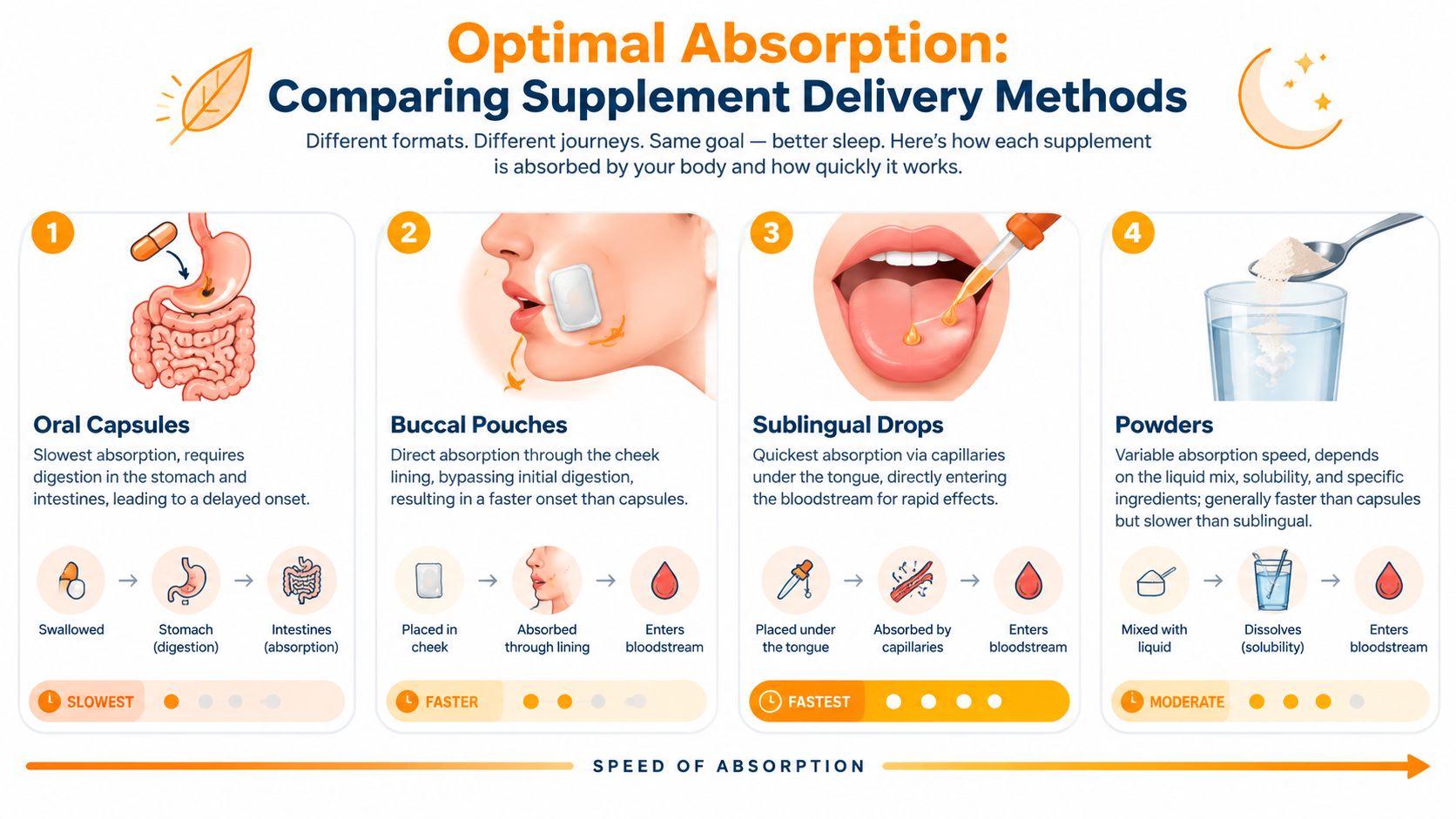
Comparing the formats
Oral capsules are familiar, portable, and easy to label. They may suit a planned routine, especially when a person wants extended-release support or takes a formula well before bed. Their slower, digestion-dependent path can be less convenient when timing is unpredictable.
Buccal pouches sit between the cheek and gum and can be useful for people who dislike swallowing pills. They may offer a faster-feeling onset than capsules, but users should follow the product instructions and avoid assuming that faster delivery means a stronger or safer effect.
Sublingual drops are placed under the tongue and are designed for rapid contact with capillaries in that area. They can suit a person who needs a compact option, though accurate measurement and consistent administration matter.
Powders work well for people who already have an evening drink ritual. Their performance depends on how completely the powder dissolves and on the formula itself, so “powder” alone doesn't predict speed.
Matching timing to work patterns
A day-shift worker with a stable bedtime can anchor the routine to the desired sleep time. A night-shift worker should anchor it to the intended daytime sleep period, while protecting that period from light and noise. A rotating worker may need a written schedule for each roster block rather than one fixed instruction.
A simple process is:
- Define the sleep window, based on when the person must be asleep rather than when the shift ends.
- Identify the target, circadian adjustment, mental calm, or sleep maintenance.
- Select the least complicated format that can be used consistently.
- Test one change at a time, so the person can identify what helps or causes grogginess.
- Review next-shift alertness, especially for safety-sensitive work.
Melatonin use is already widespread. The American Academy of Sleep Medicine's 2023 survey found that 64% of people had taken melatonin at some point, while 29% used it occasionally or regularly (AASM Sleep Prioritization Survey). Familiarity should encourage careful timing, not automatic nightly use.
Safety Considerations and Interactions
Sleep supplements can cause side effects or interact with medical conditions and medicines. Melatonin guidance lists drowsiness, headaches, vivid dreams, and next-day grogginess as possible problems, while long-term human safety evidence remains limited (medical guidance on melatonin safety and side effects).
Anyone taking medication should ask a pharmacist or clinician before starting a sleep stack. This matters particularly with blood thinners, antidepressants, sedating antihistamines, seizure medicines, or other drugs that affect alertness. Older adults, pregnant people, those with chronic conditions, and anyone who drives or operates equipment soon after waking should use extra caution.
The long-term question
Short-term use and nightly use require different decisions. Long-term nightly melatonin use still lacks extensive safety data. An observational analysis presented at the American Heart Association associated long-term use among adults with insomnia with higher heart-failure risk and mortality. Because it was observational, the analysis could not show that melatonin caused those outcomes (discussion of the observational findings and limitations).
Uncertainty calls for review rather than panic. Someone using melatonin every night can examine the underlying sleep schedule, light exposure, stress, pain, breathing, and medication timing. A clinician can help decide whether to lower the dose, shorten use, change the timing, or stop.
People exploring botanical options can read about apigenin supplement benefits. An ingredient profile does not replace an interaction check. Severe dizziness, allergic symptoms, unusual palpitations, confusion, or persistent daytime impairment warrants prompt medical advice.
Selecting Supplements for Your Lifestyle
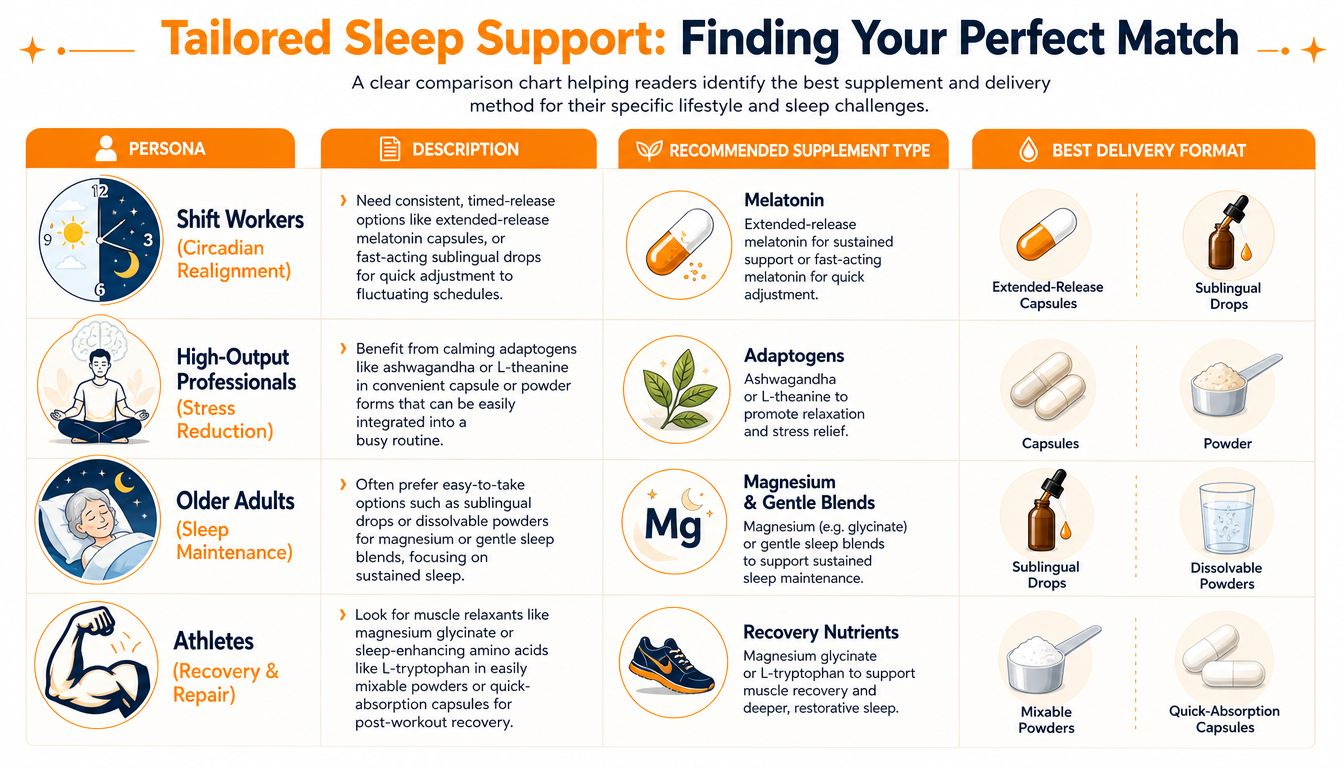
The best sleep support supplements depend on the person's schedule more than on a universal “top ten” list. A formula that works for a stable bedtime may frustrate a firefighter sleeping after a night call. A fast format may appeal to a traveler, while a slower capsule may suit someone who plans the same wind-down every evening.
Shift workers
A shift worker should prioritize circadian timing and next-shift safety. A schedule-linked melatonin plan may be more relevant than a heavily sedating blend, but the person must assess alertness before returning to duty. Evidence remains uncertain on whether supplements reliably improve performance outcomes for shift workers, so sleep quantity and work readiness shouldn't be treated as identical goals (systematic review of interventions for shift workers).
High-output professionals
A professional who struggles to switch off after calls may benefit from a simple calming routine built around reduced stimulation, journaling, and a clearly labeled relaxation ingredient. A capsule or powder can work when the person has a predictable evening. The priority is consistency and a clean next morning, not the most elaborate stack.
Biohackers and athletes
Optimization-minded users often track several variables at once, which can make cause and effect difficult to identify. A better experiment changes one ingredient or delivery format at a time and records sleep onset, awakenings, dreams, and next-day energy. Magnesium can be considered a supporting option, but current evidence doesn't justify treating it as a universal insomnia solution.
Nicotine-free pouch switchers
The oral ritual may matter as much as the ingredient. A nicotine-free user seeking an evening replacement should select a clearly labeled pouch without stimulants and avoid using the familiar ritual as permission to ignore melatonin timing or safety checks.
The right stack is the smallest stack that addresses the actual obstacle and leaves the next day intact.
Nightly Routine Checklist for Optimal Sleep
A late shift ends, a high-output professional closes the laptop, or an optimization-minded sleeper checks the clock. In each case, the same principle applies: build the routine around the intended sleep period, not someone else's bedtime. Stable cues make a supplement easier to evaluate because the surrounding habits change less.
- Three hours before sleep: Finish a light meal and avoid late caffeine or alcohol. If magnesium or a calming botanical is part of the plan, check its suitability before using it.
- Two hours before sleep: Begin reducing work demands and put devices aside. A screen-free period gives the brain fewer fresh signals to process.
- One hour before sleep: Choose a warm shower, gentle stretching, breathing practice, or journaling. Melatonin timing depends on the goal. A bedtime plan may suit sleep support, while an earlier schedule can be relevant when shifting circadian sleep onset, as noted in the earlier review.
- Thirty minutes before sleep: Keep the bedroom dark, cool, and quiet. Replace scrolling with a physical book, and drink only enough water to avoid thirst without creating repeated bathroom trips.
- In bed: Use slow breathing or a guided meditation. Jaw clenching, tooth grinding, facial pain, or morning headaches can point to stress-related bruxism. Inspire Dental Group's bruxism expertise offers context on how that pattern may affect sleep.
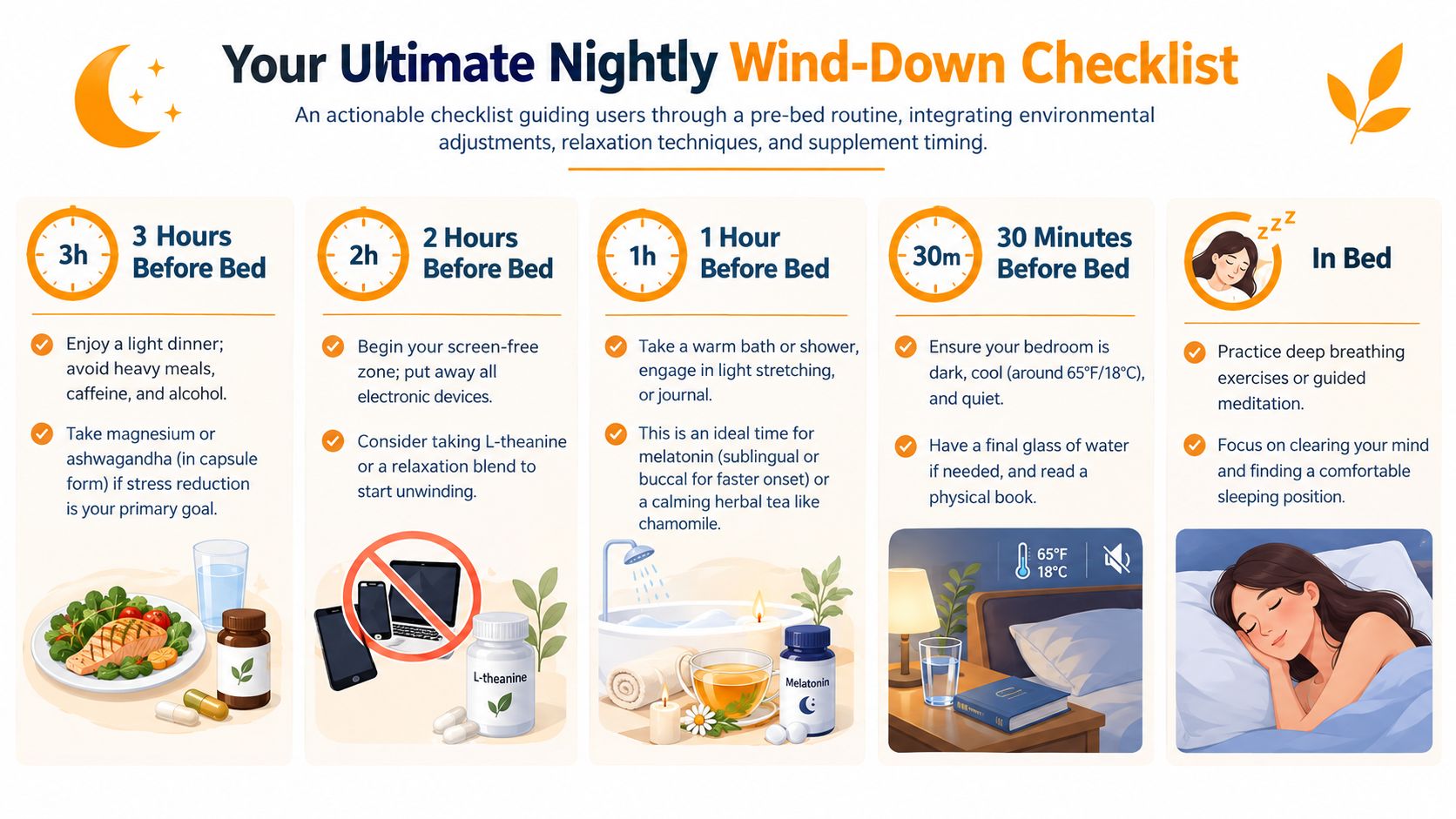
Use this guide to wind down before bed for a behavior-based routine. The goal is a repeatable sequence, with the chosen supplement serving as one cue rather than the whole strategy.
Optimal Native offers nicotine-free oral pouches for structured daytime focus and evening recovery, including an Evening Relax formula with melatonin, L-theanine, magnesium, and apigenin. Readers can explore the Optimal Native range and choose a portable format that fits a consistent wind-down routine.