

Cognitive Performance Supplements: A Practical 2026 Guide
The third coffee is sitting beside an unopened spreadsheet, and the pill bottle in the desk drawer promises focus without explaining what kind. That moment is common among professionals, gamers, clinicians, and anyone working through a long or irregular day. The useful question isn't whether a supplement feels stimulating. It's whether it improves the task at hand without damaging the sleep and recovery needed for the next one.
Table of Contents
- What Cognitive Performance Supplements Are
- The Core Daytime Ingredients and How They Work
- The Evidence on Caffeine L-Theanine and Theacrine
- Comparing Pouches Pills Coffee and Energy Drinks
- A Practical Day and Evening Protocol
- Safety Side Effects and When to Stop
- Matching Supplements to Your Daily Profile
- A Simple Framework for Choosing What to Use
What Cognitive Performance Supplements Are
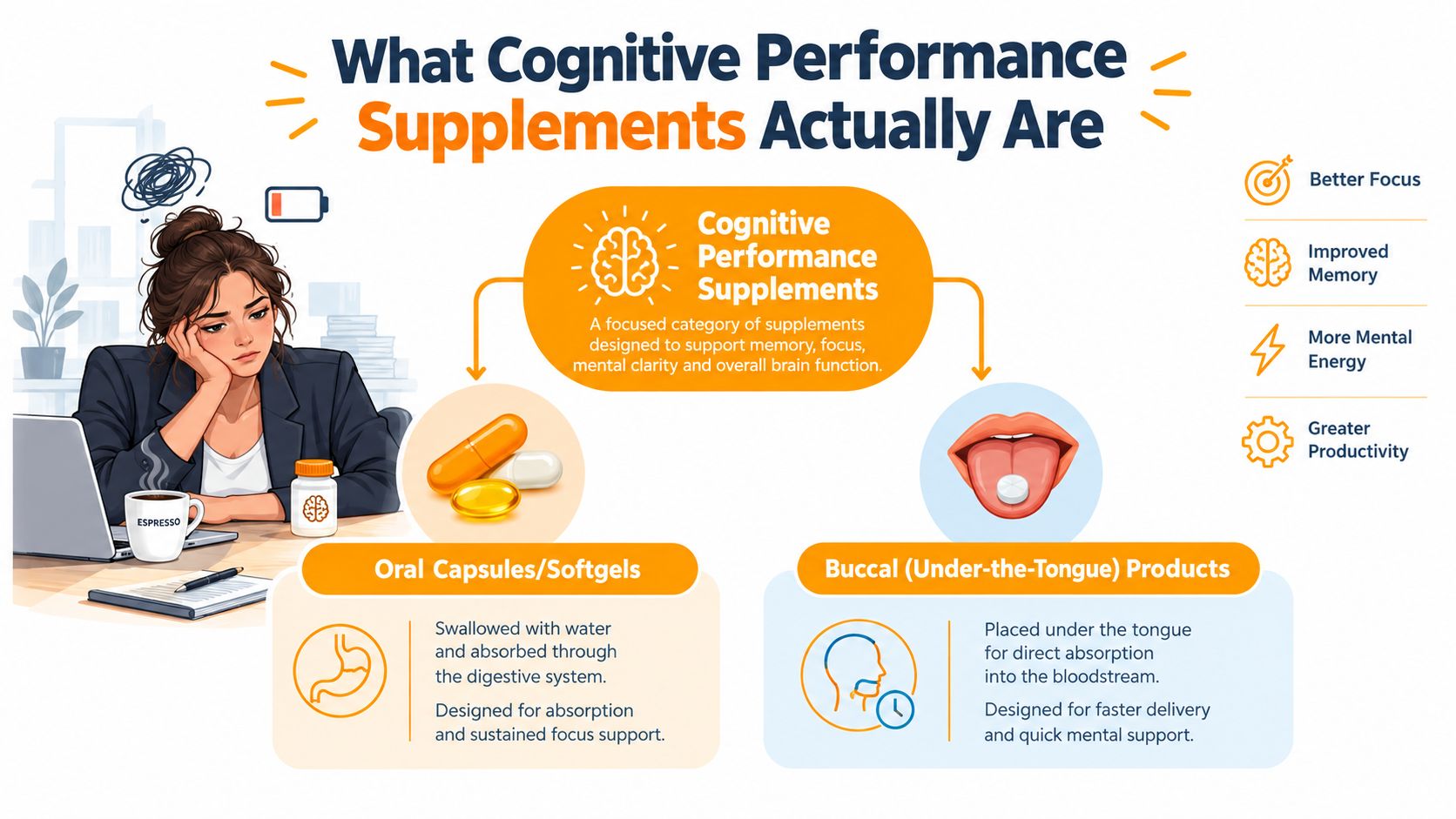
Cognitive performance supplements are oral or buccal products used to influence alertness, attention, processing speed, mental stamina, or resistance to fatigue. The category covers familiar ingredients such as caffeine and L-theanine, newer combinations involving theacrine or choline donors, and delivery formats including capsules, tablets, drinks, and oral pouches.
The category becomes clearer beside related products. Prescription stimulants are regulated medicines with a different evidence base and clinical role. Coffee is a beverage that may deliver a cognitive-active ingredient. A multivitamin supports general nutrition, while a focus product targets a more specific performance goal. Caffeine is the most widely used cognitive-performance ingredient in the available survey data, reported by 78.4% of participants in a 2022 U.S. survey of cognitive-enhancing supplements and medications (the survey and review).
Two practical jobs
A stack generally serves one of two purposes:
- Peak-state support: An ingredient is used before a demanding meeting, gaming session, exam, procedure, or concentrated writing block.
- Fatigue resilience: A shift worker or sleep-restricted professional tries to preserve attention, working memory, and decision quality through an unusually long day.
The distinction matters because alertness and recovery are separate outcomes. Caffeine may make someone feel more awake without restoring judgment impaired by sleep loss. A slower, steadier formula may fit a long shift better than a sharp stimulant, while an evening product should help wind down instead of extending work.
The timing of use is part of the protocol. A deep worker may need focused activation for a defined block, a gamer may prioritize sustained attention, and an evening user may prefer less stimulation. These choices depend on the task, schedule, and likely effect on sleep.
No supplement guarantees higher productivity, replaces sleep, or works identically for every person. Readers exploring specialized compounds can review Semax peptide brain recovery research separately, since peptide discussions belong outside ordinary over-the-counter cognitive supplements. A practical starting framework is to identify the time of day, define the problem, choose the smallest useful intervention, and protect recovery.
The Core Daytime Ingredients and How They Work
Daytime stacks work best when each ingredient has a distinct job. The table below uses study doses where the available evidence supports a clear reference point, but those doses shouldn't be treated as automatic personal instructions.
| Ingredient | Primary Mechanism | Typical Study Dose | Main Cognitive Contribution |
|---|---|---|---|
| Caffeine | Blocks adenosine signaling | Varies by study | Alertness and reduced perceived fatigue |
| L-theanine | Modulates relaxed attention | 100 mg alongside caffeine in a controlled study | Smoother attention and fewer distracting effects |
| Theacrine | Acts on related alertness pathways | Varies across studies | Longer-form stimulation, with less established evidence |
| Rhodiola rosea | May influence stress and fatigue perception | Varies by extract and study | Support during mental strain |
| Tyrosine | Precursor involved in catecholamine production | Varies by study | Possible support under acute stress |
| B vitamins | Support enzymatic and energy pathways | Varies by nutrient and formulation | Nutritional support when intake is inadequate |
| Citicoline and alpha-GPC | Provide choline-related support | Varies by study | Possible acetylcholine-related attention support |
Stimulation isn't the same as fuel
Caffeine is primarily a wakefulness tool. It antagonizes adenosine signaling, which can reduce the subjective pressure to sleep and increase alertness. Its effect is dose-dependent, but more stimulation doesn't guarantee better reasoning. A large dose can trade sleep quality and calm concentration for restlessness.
L-theanine occupies a different role. In a randomized crossover study of 27 healthy adults, 50 mg caffeine plus 100 mg L-theanine improved speed and accuracy on an attention-switching task at 60 minutes, while also reducing susceptibility to distraction in memory tasks at 60 and 90 minutes (the controlled trial). It isn't a replacement for caffeine, but it can make a stimulating combination feel less jagged.
Theacrine is often positioned as a caffeine relative with a potentially longer-feeling effect and less familiar tolerance profile. That description should remain cautious. Human evidence is smaller and less settled than the evidence for caffeine, so theacrine is better treated as an option to test rather than a proven upgrade.
Rhodiola rosea belongs closer to fatigue management than raw stimulation. Extract quality varies, and its value may be more noticeable during psychological strain than during an ordinary well-rested morning. Tyrosine is a building block involved in catecholamine production, making it most relevant when stress, sleep loss, or heavy cognitive demand may reduce mental flexibility.
B vitamins don't act like instant stimulants. They support enzymatic processes, and supplementation makes the most sense when dietary intake or status is inadequate. Citicoline and alpha-GPC are often included for choline-related support, but the evidence remains mixed across populations. Reviews of citicoline- and phosphatidylserine-containing products don't justify presenting them as universally effective cognitive enhancers.
Evening ingredients belong to a separate protocol. Magnesium, apigenin, and melatonin are used for relaxation or sleep-adjacent routines, not for extending intense daytime stimulation. A product that combines morning activation with nighttime recovery should be judged by whether its timing makes sense, not by how many ingredients appear on the label.
The Evidence on Caffeine L-Theanine and Theacrine
For a shift worker finishing a night rotation, a gamer starting a focused session, or a deep worker protecting a limited block of attention, timing matters as much as the ingredient. The strongest human evidence in this group concerns caffeine paired with L-theanine. A systematic review and meta-analysis of 11 randomized, placebo-controlled human studies found moderate effects favoring the combination during the first 2 hours after dosing, particularly for alertness and attentional switching accuracy (the meta-analysis). Caffeine dose contributed more strongly than L-theanine dose to changes in effect size during the first hour.
That evidence supports a defined use window. The pairing may improve alertness and selected attention tasks, while leaving broader factors such as sleep, movement, food, and workload unchanged. Caffeine provides the clearer wakefulness signal. L-theanine may make the resulting attention feel calmer or less tense. The benefit is narrow, applying to specific tasks within a limited window rather than producing sustained cognitive gains.
A controlled study gave healthy adults 50 mg caffeine and 100 mg L-theanine, with improvements appearing at specified testing points rather than across an entire day (the randomized crossover study). A two-hour deep-work block can therefore justify a different plan from preserving decision quality near the end of a night shift. Evening wind-down users may reasonably avoid a strategy built around extending stimulation.
Theacrine is less settled. It shares some alertness-related biology with caffeine and is often marketed as longer-acting, but human evidence remains limited. It may interest people who dislike a sharp caffeine peak or want to test another stimulant profile. Claims about reduced tolerance should stay provisional.
This comparison of L-theanine and caffeine helps readers assess the pairing as a formulation, rather than treating either ingredient as a complete answer. Habitual coffee drinkers may feel less from a familiar caffeine dose, so the practical value of any stack depends on personal response and consistent timing.
Comparing Pouches Pills Coffee and Energy Drinks
Delivery format changes the experience as much as the ingredient list. A capsule, mug, can, or pouch can contain a similar active compound while producing different habits around onset, measurement, portability, and repeated use.
| Format | Typical Onset | Dose Control | Portability | Crash Risk |
|---|---|---|---|---|
| Oral pouch | Often designed for faster buccal delivery | Discrete single serving | Very high | Depends on stimulant dose and personal sensitivity |
| Capsule | Usually slower than buccal delivery | Precise if labeled accurately | High | Depends on stimulant dose |
| Brewed coffee | Variable with preparation | Variable | Moderate | Can rise when servings become large or repeated |
| Energy drink | Often noticeable quickly | Label-dependent | High | May increase when caffeine is paired with sugar or rapid consumption |
Capsules offer measurement and repeatability. They work well for someone who wants a defined daily routine and doesn't need a sensory ritual. They also require patience, since digestion can make onset feel less immediate than a drink or oral product.
Coffee brings familiarity, warmth, and a social cue. It can also conceal how much caffeine a person is consuming when cup size, brewing method, and refills vary. Energy drinks make the same problem easier to overlook because caffeine is packaged with flavor, sweetness, and other additions. A person may finish a can before considering whether the dose fits the task or the sleep schedule.
Oral pouches occupy a different space. Buccal delivery places the product in the mouth rather than relying entirely on digestion, and a single sachet creates a clear boundary around each serving. The format is portable and avoids adding liquid volume during a commute, procedure, workout, or long shift. That convenience doesn't make the ingredients stronger or safer. It changes how the dose enters the routine.
A resource on a fast-acting energy supplement can help readers compare delivery speed and use cases without assuming that faster onset automatically means better performance.
Practical rule: Choose the format that makes the intended dose easiest to control in the real setting. Convenience should reduce accidental repetition, not encourage it.
A Practical Day and Evening Protocol
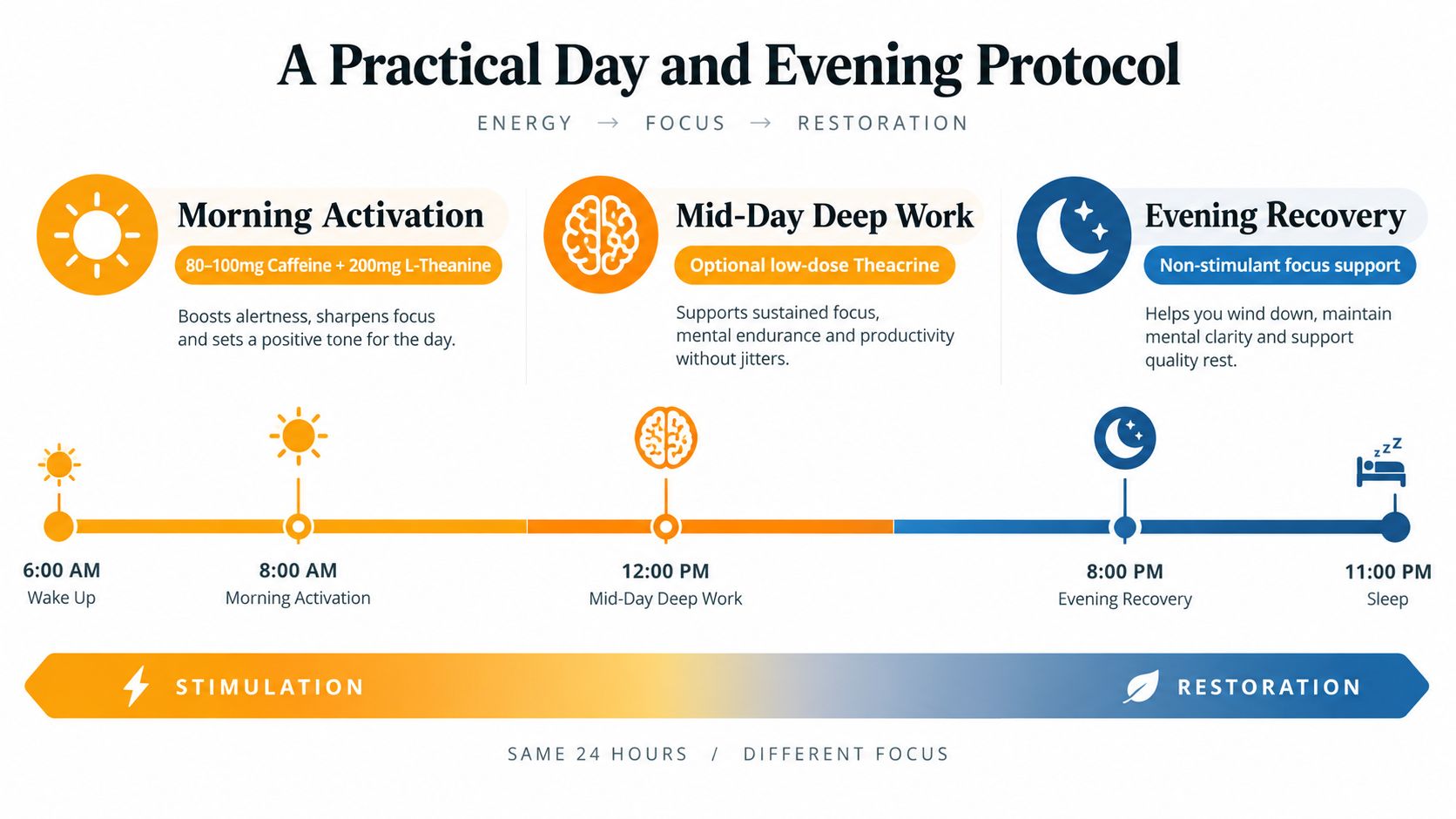
A useful daily plan has three phases: activation, focused work, and recovery. It doesn't attempt to maintain maximum stimulation from morning until bedtime.
Morning activation
A commonly used starting pattern is 80 to 100 mg of caffeine with 200 mg of L-theanine, taken on waking or shortly afterward. Those amounts come from the proposed protocol rather than the controlled trial cited earlier, so individual tolerance still matters. Breakfast, hydration, and a consistent wake time provide the foundation. The supplement shouldn't be used to cover a severely shortened night.
The first dose should serve a defined morning task. If the person feels alert without it, skipping the dose may be the better experiment. A second morning or mid-morning dose can be reserved for deep work instead of becoming an automatic refill.
Midday focus
Midday use should be situational. Some people may choose a lower caffeine serving, an oral pouch, or a cautious theacrine trial when a demanding block remains. Anyone sensitive to sleep disruption should establish a personal cutoff, with 2 pm used as a conservative boundary in the proposed routine.
The product choice should match the work. A measured capsule suits planned desk work. A portable pouch suits a hospital corridor, production floor, travel day, or outdoor assignment where a mug isn't practical. Neither format replaces a nap, a meal, or a short walk when fatigue has become the actual problem.
Evening recovery
The evening phase should remove stimulants rather than add another productivity layer. Magnesium glycinate or magnesium L-threonate may fit a dinner routine, while apigenin or L-theanine can support a calmer transition. The proposed protocol places 0.3 to 0.5 mg of melatonin about 2 hours before bed, but melatonin is not needed every night by everyone.
A person should not combine strong stimulants with alcohol, layer multiple melatonin products, or treat prescription wakefulness agents as ordinary supplements. Racetams and modafinil require particular caution and shouldn't be added casually or used late in the day without medical guidance.
A guide to choosing the best products for you can be useful when comparing general supplement categories, but the timing plan still matters more than the number of products in a cabinet.
The protocol's logic is straightforward. Morning supports initiation, midday protects task quality, and evening protects the next day.
Safety Side Effects and When to Stop
Cognitive performance supplements deserve the same scrutiny as any performance tool. A product can improve alertness while producing anxiety, palpitations, digestive problems, or poor sleep. The useful standard isn't whether the stack feels powerful. It's whether the benefit survives after side effects and next-day impairment are counted.
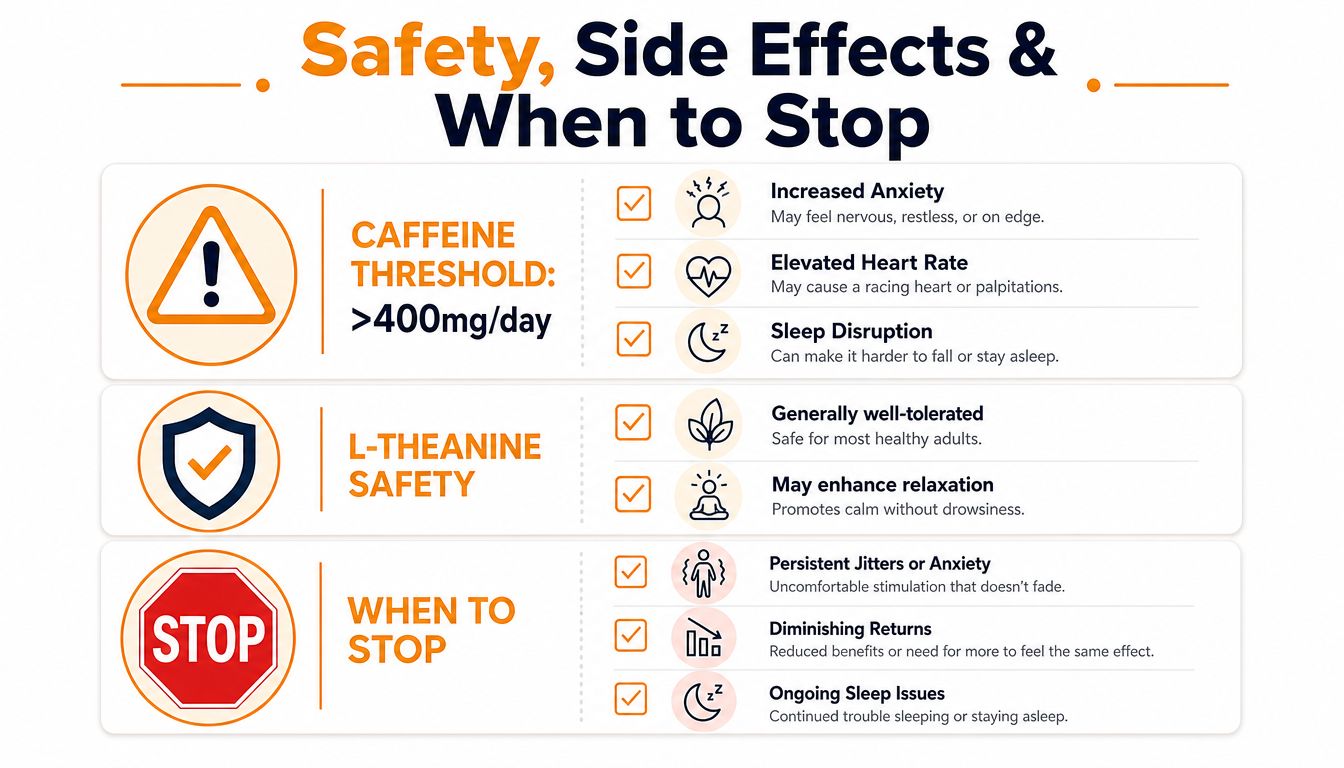
Caffeine becomes more problematic as intake rises. The proposed safety threshold of more than 400 mg per day is associated with concern about anxiety, heart rate, and sleep disruption in the supplied guidance, but sensitivity varies substantially. A person who sleeps poorly after a smaller amount shouldn't use a population threshold as permission to continue.
Theacrine may feel gentler to some users, but long-term human safety data are less established. L-theanine is generally well tolerated, while magnesium supplements can loosen stools at higher supplemental amounts. Melatonin is dose-sensitive, and taking more isn't automatically more effective.
Stop signals
A stack should be paused when the body or sleep schedule begins providing clear negative feedback:
- Heart rate changes: A resting heart rate increase of 15 beats is a proposed red flag in the supplied protocol.
- Persistent jitteriness: Typing, driving, speaking, or decision-making becomes less controlled.
- Fragmented sleep: The person wakes repeatedly or feels unrefreshed despite spending enough time in bed.
- Morning headaches: The pattern may reflect poor sleep, dehydration, or excessive stimulation.
- Mood flattening: Emotional range and motivation decline rather than improving.
This caffeine guidance on how much may be too much offers a practical starting point for reviewing total intake from coffee, drinks, capsules, and pouches. Anyone who is pregnant, takes an SSRI or blood-pressure medication, has an arrhythmia history, or manages a chronic condition should discuss a new stack with a clinician first.
Stop rule: A supplement that improves one work block but worsens the following night isn't producing a complete performance benefit.
Matching Supplements to Your Daily Profile
The right stack depends on the failure mode, not on a universal ranking. A night-shift nurse, a software developer, and an evening-reset user may all ask for “focus,” but their timing problems are different.
| Profile | Core Stack | Format | Timing |
|---|---|---|---|
| Shift worker | Caffeine or cautious theacrine, with evening non-stimulant support | Portable pouch or measured capsule | Start of the active shift, then protect the planned sleep window |
| High-output professional | Caffeine plus L-theanine | Coffee, capsule, or pouch | Morning, with a carefully limited midday option |
| Gamer or creator | Moderate alertness support, possibly theacrine | Pouch or drink | Before a defined session, not as an automatic all-day habit |
| Biohacker | One tested ingredient at a time, with light, food, and sleep tracking | Capsules or pouches | Matched to the measured performance problem |
| Nicotine-free pouch switcher | Nicotine-free ritual, with restrained stimulant exposure | Oral pouch | Use for a specific focus window, then taper ritual frequency |
| Evening reset user | Magnesium, apigenin, or carefully considered melatonin | Capsule, powder, or evening pouch | Wind-down period, not during active work |
Shift workers
Shift workers need fatigue resilience more than a dramatic energy spike. Caffeine can preserve wakefulness, but using it near the intended sleep period can shorten or fragment recovery. A worker finishing an overnight shift should think backward from the planned sleep window, then place stimulation early enough to protect it.
High-output professionals
Founders, executives, and sales professionals often need reliable attention across meetings and deep work. A morning caffeine and L-theanine pairing may suit the first demanding block, while a smaller planned option can be reserved for an afternoon dip. The clean cutoff matters more than adding another ingredient.
Gamers and creators
Gamers, editors, and streamers need sustained execution, not merely a sensation of speed. Theacrine may be interesting for experimentation, but the evidence is less mature than caffeine's. A session-based pouch can also prevent the repeated sipping that turns one work block into uncontrolled intake.
Biohackers and pouch switchers
Biohackers should resist stacking every plausible mechanism at once. Citicoline, rhodiola, timed light exposure, and caffeine can all appear reasonable, but multiple simultaneous changes make it impossible to identify what helped.
People moving away from nicotine pouches may value the oral ritual itself. A nicotine-free pouch can preserve the behavioral cue without nicotine, but replacing one automatic habit with another stimulant habit still requires boundaries.
Evening-reset users should treat sleep as the primary performance supplement. Magnesium, apigenin, and low-dose melatonin may fit a wind-down routine, but none should be used to justify late stimulation.
A Simple Framework for Choosing What to Use
A practical decision process begins before the supplement aisle.
- Audit the foundation. Sleep regularity, hydration, movement, food timing, morning light, and a suitable work environment often improve cognition more reliably than another capsule. A supplement should solve a defined gap, not compensate for every neglected basic.
- Name the failure mode. Is the problem morning fog, an afternoon dip, distraction during deep work, post-shift fatigue, or difficulty winding down? Each problem points toward a different intervention and time window.
- Choose one variable. Start with one ingredient or one simple combination at a conservative study-informed amount. A person who changes caffeine, theacrine, rhodiola, sleep timing, and meal timing together won't know which change caused the result.
- Match format to context. Pouches suit portable, time-specific use. Capsules suit measured routines. Coffee suits people who value a beverage ritual and can estimate intake. Energy drinks require closer attention to the label and the rest of the day's caffeine.
- Set a stop rule. Decide in advance what counts as failure, such as persistent jitteriness, impaired sleep, rising resting heart rate, or no meaningful task benefit. If tolerance grows, reducing frequency or taking a planned break is more sensible than escalating the dose.
A reader comparing a daily focus supplement pack should ask whether the bundle separates daytime activation from evening recovery, identifies the amount of each active ingredient, and explains who should avoid it. Product complexity isn't evidence of effectiveness.
Three questions should precede any purchase:
- What exact task or time window needs support?
- What ingredient has credible human evidence for that situation?
- What will be the stop rule if sleep, mood, heart rate, or concentration worsens?
A time-anchored protocol keeps cognitive performance supplements in their proper role. They can support a demanding block, but they can't replace recovery, and they shouldn't turn every low-energy moment into a reason to stimulate.
Optimal Native offers nicotine-free oral pouches organized around morning activation, daytime focus, and evening wind-down, using ingredients such as caffeine, theacrine, L-theanine, B vitamins, melatonin, magnesium, and apigenin across its formulas. Readers who want to compare a time-structured pouch approach with capsules, coffee, or standalone ingredients can visit Optimal Native and review the formulations before deciding.