

Deep Work vs Shallow Work Guide for Focused Days
A knowledge worker can be interrupted roughly every 11 minutes, then need about 23 minutes to fully return to the original task, according to research associated with Gloria Mark at the University of California, Irvine, as summarized by research on the deep work versus shallow work distinction. The interruption may last seconds. The recovery cost can consume the rest of the intended focus window.
That pattern explains a familiar workday. Email gets answered, chat threads get cleared, status updates get posted, and meetings get attended, yet the analysis, code, strategy document, or clinical reasoning that required sustained attention remains unfinished. The problem isn't a lack of effort. It's a work system that lets coordination occupy every gap.
Table of Contents
- Introduction Why Your Focus Feels Fragmented
- What Deep Work and Shallow Work Actually Mean
- Deep Work vs Shallow Work Side by Side Comparison
- The Hidden Cost of Switching and Attention Residue
- When to Use Each Mode Real World Use Cases
- How to Schedule Deep and Shallow Work in a Daily Protocol
- Choosing Your Focus Strategy and Next Steps
Introduction Why Your Focus Feels Fragmented
A fragmented day often starts innocently. A developer opens a design document, notices a message from a product manager, replies quickly, checks a ticket, returns to the document, and then joins an unplanned call. A nurse, paramedic, or security operator may face an even harder version of the same problem, where interruptions aren't optional and rapid response is part of the job.
By late afternoon, both workers can feel busy without having produced the output that demanded their best thinking. The distinction between deep work vs shallow work helps because it treats focus as an operating decision, not a character test. Shallow work isn't automatically wasteful, and deep work isn't always possible. The practical question is how to protect valuable concentration while keeping essential coordination moving.
The strongest focus systems start by labeling tasks accurately. Writing a difficult proposal, debugging a complex system, synthesizing research, and making a strategic decision require sustained mental effort. Scheduling, routine updates, message triage, and basic information routing can usually tolerate more fragmentation.
Practical rule: Protect the task that becomes materially worse when interrupted. Batch the task that can wait without creating operational risk.
This guide uses that rule to examine the cost of switching, the role of attention residue, and the minimum viable focus window for interruption-heavy roles. It also addresses the reality that many people can't vanish for several hours. Managers, clinicians, responders, and client-facing operators need shorter protocols that preserve quality without pretending interruptions can be eliminated.
Teams working with automation face the same tension. Practical tips for automation teams can help reduce repetitive coordination, but automation only creates capacity if the freed time is directed toward work that requires judgment. A useful starting point for any role is why focus is important, especially when the workday feels full but progress on high-value outcomes remains thin.
What Deep Work and Shallow Work Actually Mean
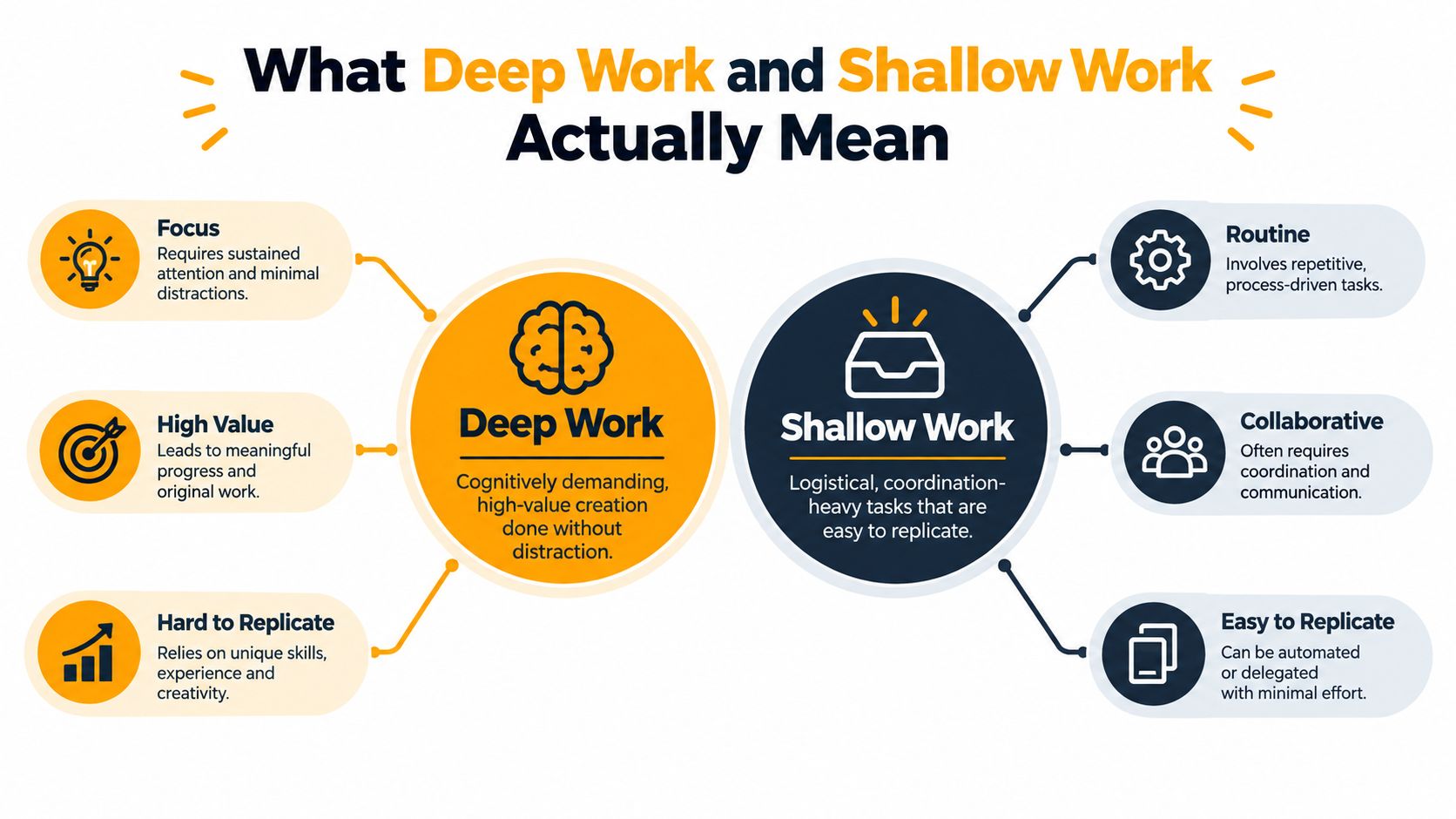
Deep work is cognitively demanding, high-value creation performed with limited distraction. It includes tasks such as building a system architecture, drafting a difficult argument, analyzing conflicting evidence, writing original content, or planning a complex intervention. The output usually depends on expertise, working memory, synthesis, and error-sensitive judgment.
Shallow work is logistical and coordination-heavy. It includes email, chat responses, calendar changes, routine reporting, ticket maintenance, status collection, and straightforward information sharing. These tasks still matter because they keep people aligned and operations current. They're easier to replicate, delegate, or complete while attention is divided.
Cal Newport made the modern vocabulary mainstream through Deep Work: Rules for Focused Success in a Distracted World, published in 2016. The framing drew on earlier research into task switching and attention residue, but Newport gave the business world a clear distinction between cognitively valuable creation and the administrative activity surrounding it. That distinction became especially relevant as digital workplaces filled with persistent messaging, shared documents, project platforms, and meeting systems.
A simple classification test
A task usually belongs in the deep category when it has several of these characteristics:
- It requires expertise: A trained specialist must interpret, synthesize, or decide.
- It creates differentiated output: The result can't be produced reliably from a simple template.
- It suffers under interruption: Each pause forces the worker to reconstruct context.
- It has meaningful error exposure: A missed relationship, flawed assumption, or incomplete check can create rework.
Shallow work tends to have a different profile. A colleague can learn it relatively quickly, the task has a repeatable workflow, and interruptions don't destroy the underlying reasoning. A routine approval may be shallow for one person but deep for another if it requires unusual risk assessment or domain judgment.
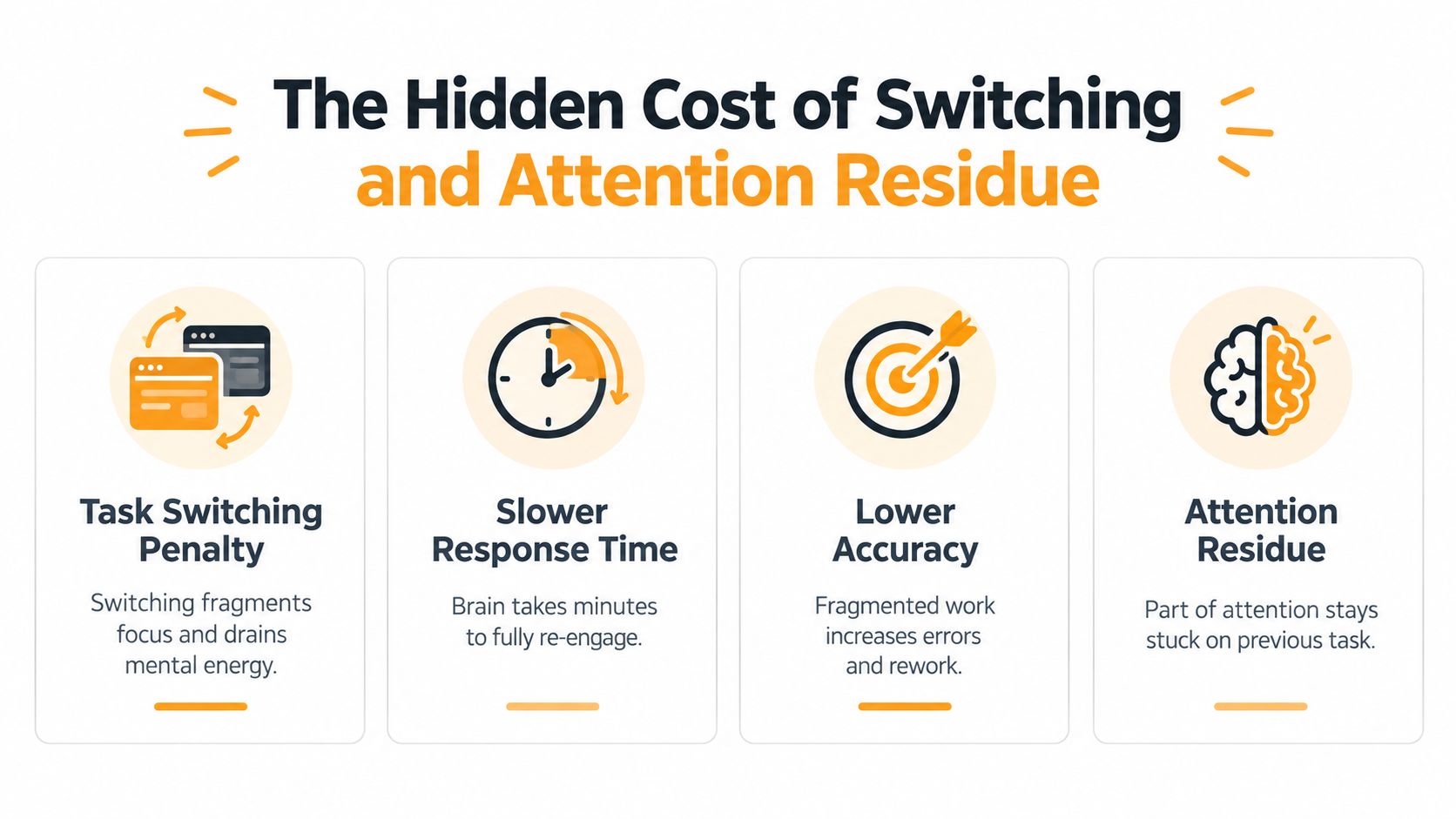
Attention residue describes what happens after a switch. Part of the worker's attention remains attached to the previous task, so the next task doesn't receive full cognitive capacity immediately. The idea matters because closing a document or finishing a message doesn't guarantee that the mind has cleanly disengaged. Readers looking for practical deep work productivity tips should therefore focus less on heroic hours and more on reducing avoidable transitions.
Deep Work vs Shallow Work Side by Side Comparison
Deep work and shallow work shouldn't be treated as competing moral categories. A hospital unit needs handoffs, triage, documentation, and coordination. A software team needs incident updates, review comments, and ticket changes. The distinction becomes useful when the calendar gives both modes the same status and lets shallow activity consume the conditions required for deep output.
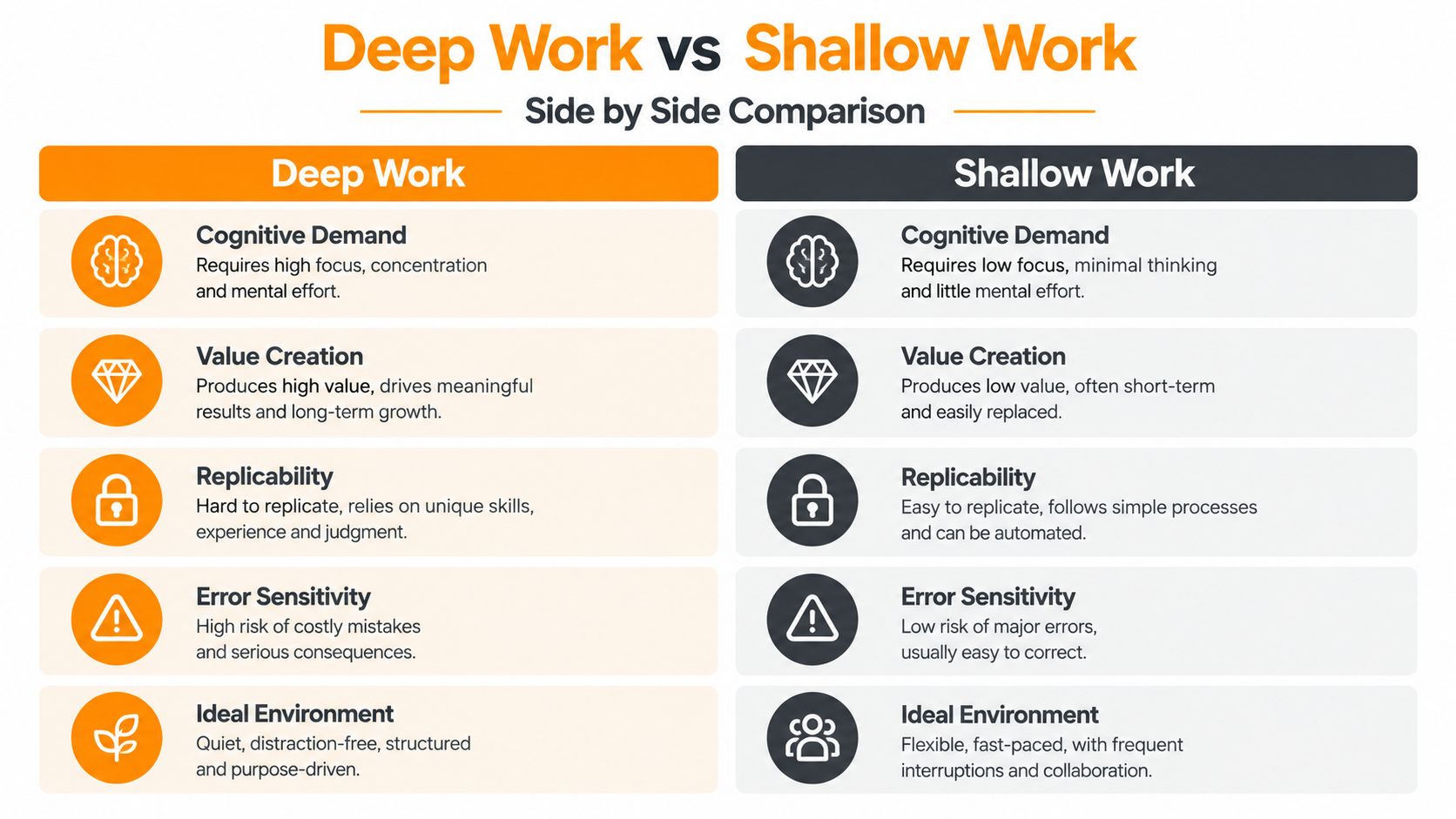
| Criteria | Deep Work | Shallow Work |
|---|---|---|
| Cognitive demand | High, sustained reasoning and working memory | Lower, procedural or coordination-focused effort |
| Value creation | Produces original, strategic, or technically difficult output | Maintains flow of information and routine operations |
| Replicability | Difficult to hand off without expertise and context | Often repeatable, teachable, or delegable |
| Error sensitivity | Interruptions can cause omissions, flawed reasoning, and rework | Errors still matter, but workflows often support checking |
| Ideal environment | Protected attention, clear scope, minimal notifications | Accessible communication channels and predictable response windows |
The trade-off is operational, not ideological
Deep work creates value by allowing a person to hold more relationships, constraints, and possibilities in mind at once. A strategist can connect customer evidence to commercial priorities. An engineer can trace a failure across services. A writer can maintain an argument instead of assembling disconnected paragraphs.
Shallow work maintains the conditions around that creation. It surfaces missing information, confirms ownership, updates the shared record, and makes the next decision easier. Treating every message as useless can create ambiguity that later makes deep work slower. Treating every message as urgent can prevent deep work from starting at all.
Deep work compounds expertise and produces difficult-to-replicate output. Shallow work keeps the system coordinated so that output can move.
The error risk also differs by task. A routine status update may be safe to process between meetings. A medication-related decision, incident analysis, financial model, or legal argument may not be. In the second group, a brief interruption can force the worker to restart a chain of reasoning and increase the chance of overlooking a dependency.
Environment should follow the work. A deep block needs a narrow objective, a defined stopping point, and a channel for urgent exceptions. Shallow work benefits from visible queues, templates, shared ownership, and batching. The best teams don't ask every task to happen in the same environment. They design separate lanes.
The accompanying video provides another way to visualize the distinction between focused creation and fragmented coordination:
The Hidden Cost of Switching and Attention Residue
Task switching creates a performance penalty even when the worker feels capable of handling several threads. Research summarized in a recent attentional-demand validation study found that divided attention produced slower response times and lower accuracy than selective attention, with switching effects that were not evenly distributed across attention conditions (Frontiers in Psychology). The practical point is simple. Switching doesn't just make work feel tiring. It can degrade speed and quality.
The penalty becomes more serious when the task depends on memory. Independent research on attention residue found that switching leaves part of attention attached to the previous goal, and switch conditions harmed long-term memory for switched items compared with repeat conditions (the cited attention-residue research). A worker may complete the first task and still carry enough unresolved context into the next task to reduce performance.
Why short interruptions create long recovery
An interruption has two parts. First, the worker responds to the new demand. Second, the worker reconstructs the old task, including its goal, evidence, open questions, and next action. The second part is easy to miss because it doesn't appear in a calendar or task tracker.
The workplace impact is especially severe when interruptions arrive continuously. Recent workplace analysis reported that focus efficiency fell to 60% in 2025, average focused sessions declined to 13 minutes 7 seconds, and workers faced a ping roughly every two minutes during core hours (ActivTrak's State of the Workplace). Those figures make long, uninterrupted blocks unrealistic for some roles, not merely difficult.
The correct response isn't to demand perfect concentration from everyone. It's to match the protocol to the interruption pattern.
- For predictable interruptions: Reserve a protected block and publish the return time.
- For uncertain interruptions: Define an exception channel and keep the working objective small enough to resume.
- For unavoidable response roles: Use short focus windows after the operational peak, then leave a written restart note.
The efficiency gain comes mainly from avoiding unnecessary switch overhead, not from forcing the brain to work faster. A ten-minute window with one clear objective can be valuable if it isn't repeatedly broken. A longer block may produce less if notifications, meetings, and unresolved messages keep pulling attention away.
When to Use Each Mode Real World Use Cases
The right mode depends on the task, not the job title. A product manager may spend one hour in deep work writing a product specification, then shift into shallow coordination to collect decisions from engineering and design. A manager may perform shallow triage during an active escalation, then need deep work to prepare feedback, redesign a process, or plan staffing.

Where deep work earns protection
Deep work deserves priority when the deliverable requires integrated reasoning or original judgment.
- Software engineering: Architecture, complex debugging, algorithm design, and structural code review need continuity because each decision depends on the previous one.
- Writing and content strategy: Research synthesis, argument design, and substantial drafting lose quality when the writer repeatedly shifts into inbox maintenance.
- Analysis: Modeling, diagnosis, and interpretation require the worker to compare evidence instead of reacting to isolated inputs.
- Leadership: Strategic planning, performance review writing, and operating-model design require preparation that can't be improvised between messages.
- Clinical and emergency work: During protected documentation, case review, training, or planning windows, a clear objective and controlled interruptions can reduce avoidable cognitive fragmentation.
Where shallow work enables depth
Shallow work becomes useful when it removes ambiguity. A researcher may gather missing data before beginning analysis. An engineer may clarify requirements before designing a solution. A shift leader may confirm staffing, priorities, and escalation paths before using a quiet window for planning.
The sequence matters:
- Clarify the input: Collect the information needed for a decision.
- Batch coordination: Ask related questions together rather than scattering them across the day.
- Protect the reasoning window: Work from a prepared brief with a defined outcome.
- Return to coordination: Share the result, record decisions, and assign follow-through.
For people whose work depends on sustained reasoning, problem-solving and focus belong in the same operating conversation. A focus block without a clear problem can turn into passive reading, while a well-defined problem can make a short window productive.
A responder or clinician may never receive a clean morning block. That doesn't eliminate deep work. It changes the unit of scheduling from a large idealized session to a reliable, portable window tied to the shift's natural lulls.
How to Schedule Deep and Shallow Work in a Daily Protocol
A practical protocol starts with task sequencing, not a perfect calendar. The worker identifies the most cognitively expensive deliverable, prepares its inputs, and places it before routine coordination whenever the role allows. When the role doesn't allow that sequence, the worker creates smaller windows around predictable operational cycles.
Build the day around the work's recovery cost
For a desk-based knowledge worker, the first protected window should have one outcome, such as completing the analysis outline, resolving a defined code path, or drafting a specific section. Notifications go off, the phone leaves reach, and the calendar status tells colleagues when replies resume. Email and chat then move into a later batch rather than leaking into the focus window.
A useful daily pattern looks like this:
- Activation window: Review the priority, gather inputs, and define the next visible output.
- Protected focus window: Work on one complex deliverable without routine notifications.
- Coordination window: Process email, chat, approvals, and scheduling in a shared batch.
- Second focus opportunity: Use another quiet period for continuation or a smaller reasoning task.
- Closeout window: Record decisions, send necessary updates, and write the restart note.
Calendar control helps, but a block only works when others can see its boundaries. Guidance on planning calendar blocks for entrepreneurs is useful for making those commitments visible and easier to maintain when meetings compete for open space.
Use minimum viable deep-work windows
Many workers can't protect a long block. A manager may be waiting for an escalation. A clinician may be called away. A responder may have a quiet interval that ends without warning. In these conditions, the minimum viable window should be long enough to complete a meaningful cognitive unit, not long enough to satisfy a productivity slogan.
For a 10-minute window, the task might be writing a decision outline, identifying the next debugging hypothesis, or extracting the key finding from a document. For a 20-minute window, it may be drafting a section, checking a model assumption, or preparing a focused handoff. For a 30-minute window, it can support a substantial continuation if the worker begins with a prepared restart note.
Each window needs three controls:
- A narrow target: Define what will exist when the window ends.
- A restart marker: Leave the next action in plain language before switching away.
- A recovery buffer: Don't schedule an immediate complex task after a disruption and assume full focus has returned.
The guide to improving focus at work can support the environmental side of this protocol, but the central discipline remains sequencing. Short focus windows work best when shallow preparation has already removed obvious ambiguity.
Choosing Your Focus Strategy and Next Steps
The best strategy isn't “deep work all day.” It's a hybrid operating system that protects difficult reasoning and deliberately contains coordination.
Use this decision matrix:
| Situation | Primary mode | Operating choice |
|---|---|---|
| The task needs synthesis, expertise, or original judgment | Deep work | Protect the clearest available window |
| The task is repeatable and interruption-tolerant | Shallow work | Batch it into a communication window |
| Missing information would cause rework | Shallow work first | Gather and clarify inputs before focusing |
| Interruptions are structurally unavoidable | Short deep windows | Define small outputs and restart notes |
| A decision is urgent and high risk | Focused response | Reduce competing inputs and verify the critical facts |
A weekly audit should answer a few direct questions:
- Which deliverable remained unfinished despite substantial activity?
- Which notification or meeting repeatedly broke concentration?
- Which shallow task could be batched, delegated, automated, or removed?
- Which quiet period reliably appears during the workday or shift?
- What is the smallest useful output that fits that period?
The first intervention should be narrow. Move one recurring coordination batch away from the best cognitive window. Protect one repeatable focus opportunity. Create one visible exception path for urgent requests. Then evaluate whether the important deliverable is moving, rather than judging success by the number of messages processed.
Shallow work isn't the enemy. Unsequenced shallow work is. It can prepare the evidence, clarify ownership, and preserve operational continuity, but it shouldn't consume every period in which complex work could happen. The goal is not to eliminate responsiveness. It's to make responsiveness serve the output that matters.
Optimal Native offers a nicotine-free, sugar-free pouch system organized around morning activation, daytime focus, and evening wind-down, giving busy professionals and shift workers a portable routine to pair with deliberate focus blocks. Visit Optimal Native to explore the protocol and choose a more structured way to support demanding workdays.