

Dip Tobacco Flavors Explained and Smarter Alternatives
A tin sits on the counter, and the choice seems simple. Wintergreen suggests a sharp, cooling sensation. Mint sounds cleaner and possibly milder. Peach or berry promises sweetness, while straight appears to offer a more traditional tobacco taste. Yet the label doesn't reveal why two products with similar flavor names can feel completely different under the lip.
Dip tobacco flavors do more than add aroma. They can influence how users perceive bitterness, sting, moisture, cooling, and strength. Flavor also works alongside pH, humectants, and the tobacco blend to shape how nicotine is released at the mouth's surface. A product that feels smoother isn't necessarily less intense, and a pleasant taste doesn't make tobacco harmless.
This guide separates the parts of the experience that are often blended together. It looks at flavor vocabulary first, then sensory chemistry, common flavor families, regulation, and nicotine-free pouch alternatives. Readers comparing oral products can also review the practical differences between chewing and dipping, because the format and ritual affect how flavor is experienced.
Table of Contents
- Introduction to Dip Tobacco Flavors and Why They Matter
- How Dip Tobacco Flavor Categories Work
- How Flavor and pH Shape the Dip Experience
- Most Common Dip Tobacco Flavor Profiles Compared
- Flavor Harm Perception and Changing Regulations
- Nicotine Free Pouch Alternatives That Mimic Familiar Flavors
- Choosing Your Next Step With Flavor and Focus in Mind
Introduction to Dip Tobacco Flavors and Why They Matter
Choosing among dip tobacco flavors often begins with a familiar question: does the product taste cold, sweet, earthy, or sharp? A wintergreen tin may create expectations of a strong cooling note, while a fruit-labeled product may seem more approachable because sweetness can soften tobacco bitterness. Those expectations affect the first few minutes of use, including whether the product feels harsh, dry, heavy, or smooth.
Flavor has played this role for a long time. Historical records describe flavored smokeless tobacco products using peach, apple, honeysuckle, champagne, and prune as early as the 1870s, while the first wintergreen-flavored chewing tobacco product, Skoal moist snuff, appeared in 1934. By the 1960s, flavoring had become more common in smokeless tobacco marketing, making flavor a long-running strategy rather than a recent novelty. The history is documented in this review of flavored tobacco development.
Flavor changes interpretation
A flavor doesn't erase tobacco's underlying chemistry. It changes the signals the mouth and nose receive. Cooling compounds can reduce the impression of burn, while sweet or fruity notes can distract from bitterness. Moisture and texture then reinforce the impression, much like the difference between a dry black coffee and a sweetened, chilled coffee drink.
That distinction matters because users often treat smoothness as a sign of lower strength or lower risk. In reality, a product can feel comfortable while still delivering nicotine efficiently. Sensory comfort and exposure aren't the same measurement.
What readers should take from the label
A flavor name usually communicates only part of the product experience. It may identify the dominant aroma, but it doesn't fully describe:
- Cooling: Whether the product creates a menthol-like or mint-like chill.
- Sweetness: Whether fruit, candy, or other notes soften tobacco bitterness.
- Body: Whether the dip feels wet, dense, fibrous, or light.
- Perceived impact: How quickly the user notices tingling, burn, or nicotine effects.
Understanding those layers helps readers compare products more carefully and recognize why a switch to a nicotine-free pouch may preserve the oral routine without preserving nicotine exposure.
How Dip Tobacco Flavor Categories Work
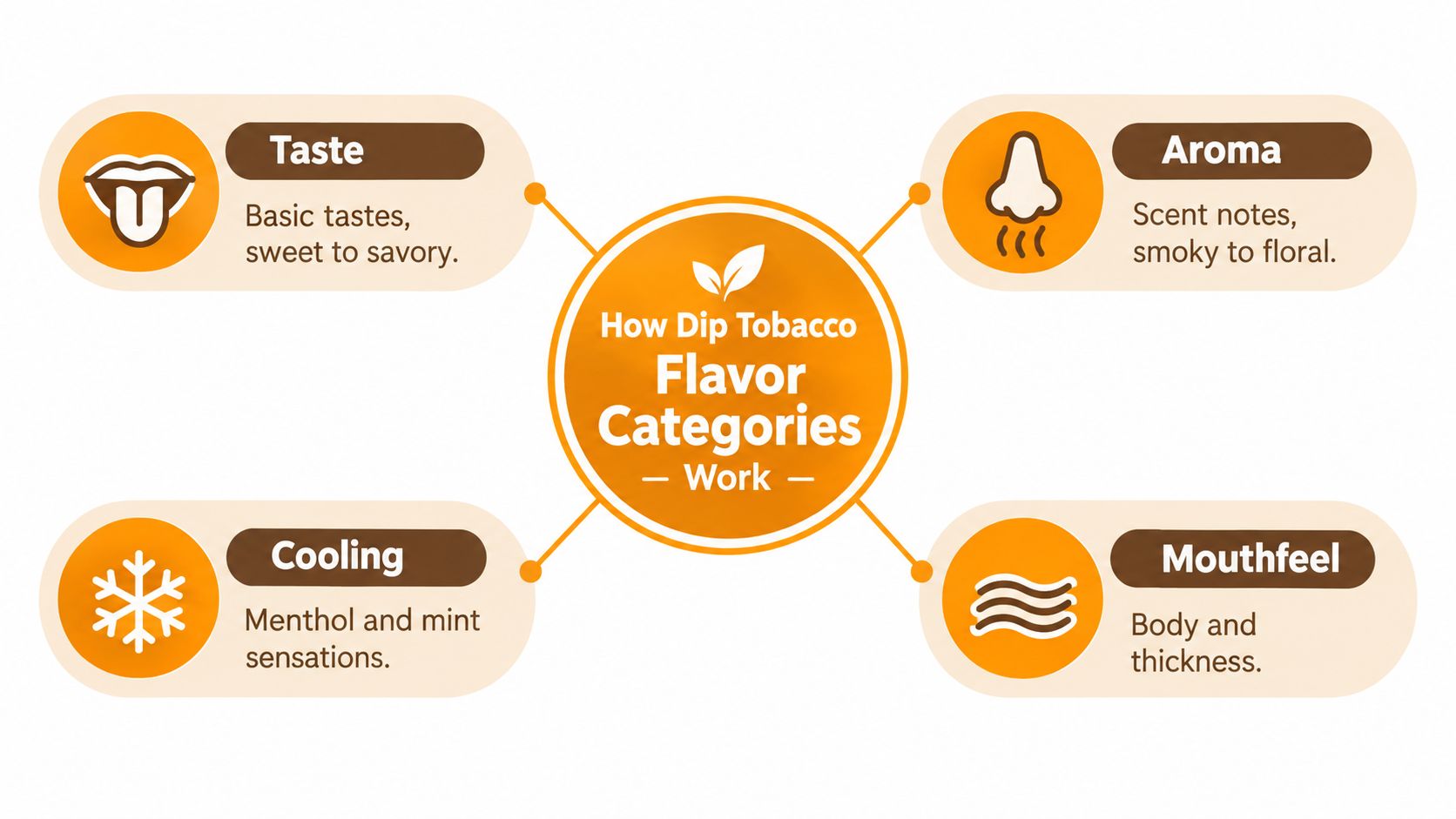
Dip flavors become easier to understand when taste, aroma, cooling, and mouthfeel are treated as separate systems. A label such as “wintergreen” mainly signals aroma and cooling. It doesn't tell the reader how sweet the product is, how moist the tobacco feels, or how forcefully nicotine effects may arrive.
Taste and aroma aren't interchangeable
Taste comes from basic signals such as sweetness, bitterness, sourness, saltiness, and savoriness. Aroma comes from volatile compounds reaching the nose, both while the product is handled and while it rests in the mouth. A fruit profile may taste only mildly sweet but smell strongly like peach or berry, just as coffee can smell rich while tasting bitter.
Common naming groups include:
- Wintergreen: Usually associated with a distinct cooling, sweet-herbal character and a noticeable aromatic lift.
- Mint or spearmint: Often presents as fresh, green, and cooling, with spearmint tending to sound softer or sweeter than a sharper mint profile.
- Fruit: Includes notes such as peach, apple, citrus, berry, or tropical fruit. These profiles can make tobacco taste less dominant.
- Candy or sweet: Signals a more overtly sugary or confectionery impression, though the exact sensation varies by formulation.
- Alcohol-inspired: Names such as champagne can suggest fruit, floral, or sparkling aromatic associations without defining the product's nicotine strength.
- Straight or natural: Usually points toward earthy, tobacco-forward notes with less emphasis on cooling or sweetness.
Cooling is a physical sensation
Mint and wintergreen don't only provide flavor. They can trigger cooling sensations through oral sensory pathways. That creates a temperature-like impression even when the product itself isn't cold. The effect can make a strong product seem cleaner or less abrasive, especially when the user focuses on the chill rather than the underlying tobacco sting.
Strength and flavor are separate choices
A flavored product isn't automatically weak, and a straight product isn't automatically strong. Flavor identity describes the sensory profile. Strength depends on factors such as nicotine concentration, pH, moisture, and how the product is used. Cut also changes handling and texture, but it shouldn't be confused with flavor intensity.
Practical rule: Compare flavor, cooling, moisture, cut, and expected strength as separate attributes. A label that answers only one of those questions can't describe the whole experience.
How Flavor and pH Shape the Dip Experience
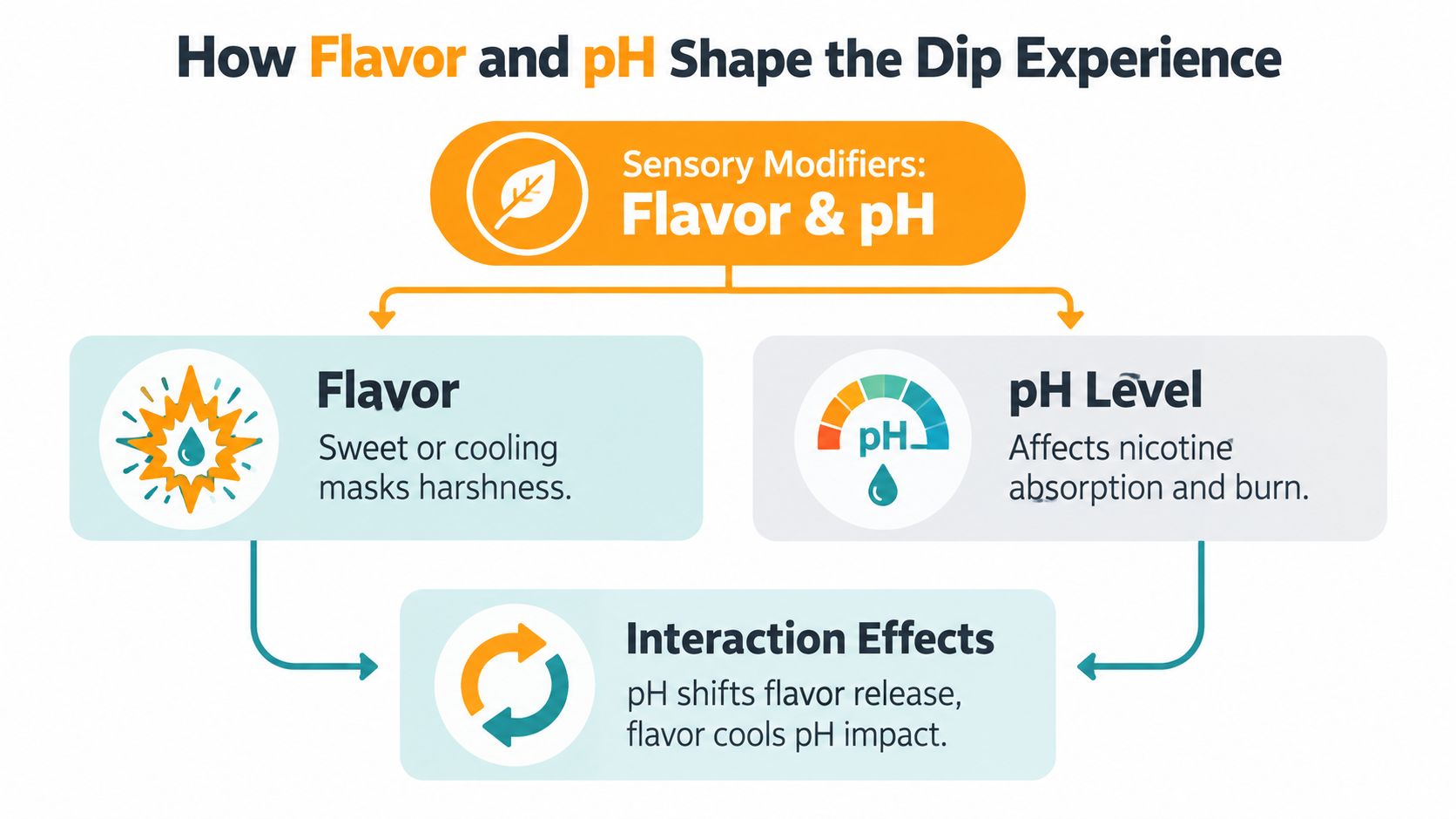
A dip can taste smoother than it acts. Flavor systems soften bitterness and oral sting, while pH helps decide how nicotine behaves once the product is in the mouth. In smokeless tobacco, products buffered above pH 5.5 shift more nicotine into the unprotonated free-base form, which crosses the buccal mucosa more readily. That chemistry is described in this independent analysis of pH and nicotine in smokeless products.
A useful analogy is a locked door. Protonated nicotine is like a molecule carrying a key that does not fit the doorway easily. Unprotonated nicotine is more able to pass through the oral lining. Raising alkalinity changes the balance between those forms, which can affect delivery speed and perceived impact.
The chemistry has a measurable range
Independent product analyses found acidic products around pH 5.20 to 5.74 had only 0.12% to 0.26% unprotonated nicotine. Basic products around pH 8.17 to 10.07 had 58.55% to 99.12% unprotonated nicotine, according to the same product analysis. Those figures do not mean every wintergreen or mint product has the same pH. They show why flavor names alone cannot predict delivery.
A cooling flavor can hide harshness while an alkaline matrix increases the amount of nicotine available at the oral surface. The result may feel smoother while still landing with more intensity. Two products both labeled “mint” can still differ in burn, onset, and lingering mouthfeel.
Flavor works with the rest of the formulation
Formulators tune several variables together:
- Flavor additives: Suppress bitterness, add sweetness, or create cooling.
- Moisture: Changes softness, release, and how long flavor remains noticeable.
- Humectants: Help retain moisture and influence texture.
- pH buffers: Shift nicotine chemistry and can affect burn and release.
- Tobacco cut: Changes packing, surface area, and physical presence.
A policy review notes that flavors can mask nicotine's bitterness and oral sting, and that some flavor systems may be used alongside pH adjustments to make oral nicotine products more appealing. That same logic helps explain why nicotine-free pouches can feel familiar at first, even without tobacco chemistry driving the experience. Flavor is part of product engineering, not decoration.
Most Common Dip Tobacco Flavor Profiles Compared
Retail shelves tend to organize dip tobacco flavors around a few recognizable families. Wintergreen and mint remain the clearest cooling profiles, while fruit and sweet blends make tobacco less prominent. Straight or natural products place the tobacco character in the foreground.
The following comparison focuses on sensory expectations, not nicotine strength. Actual experiences vary with moisture, cut, formulation, and pH.
| Flavor Family | Typical Notes and Feel | Common Appeal |
|---|---|---|
| Wintergreen | Sweet-herbal aroma, pronounced cooling, lingering freshness | Users seeking a familiar, high-impact cooling profile |
| Mint and spearmint | Clean, green, cooling notes, with spearmint often seeming softer | Users who want freshness without a strong fruit character |
| Fruit | Peach, apple, berry, citrus, or tropical impressions with sweetness | Users who prefer less tobacco bitterness and a more approachable aroma |
| Candy and sweet blends | Confectionery sweetness layered over tobacco or mint | Users drawn to a softer, sweeter first impression |
| Natural or straight | Earthy, woody, roasted, or tobacco-forward notes | Users who want the leaf character without a dominant cooling layer |
| Fusion profiles | Blended fruit, mint, citrus, or aromatic notes | Users interested in a more modern or complex sensory profile |
Wintergreen and mint
Wintergreen typically delivers a recognizable cooling effect with a sweet, assertive aroma. Mint can be cleaner or greener, while spearmint may seem rounder and less severe. Neither category reliably predicts how much nicotine the product delivers.
Some users select these profiles because the cooling sensation provides a sense of freshness. Others find that the same sensation draws attention to the gums or creates a stronger impression of oral intensity.
Fruit and sweet profiles
Fruit notes can make a product feel more familiar to someone who dislikes a pronounced tobacco taste. Peach, apple, berry, and citrus profiles each create different expectations, but their shared function is often to redirect attention away from bitterness.
That doesn't mean every fruit product is mild. Sweetness can coexist with substantial burn, moisture, or nicotine delivery. Readers comparing a wintergreen product with a fruit product should ask whether the difference comes from flavor, pH, or the combined sensory design.
Natural and straight profiles
Straight tobacco profiles are less buffered by bright cooling or fruit aroma. Earthy notes become easier to notice, including roasted, woody, fermented, or smoky impressions. Users who prefer traditional character may find this more satisfying, while others may experience the bitterness and sting more directly.
A product-specific example can help readers understand how brand naming affects expectations. The discussion of Grizzly Wintergreen dark pouches illustrates why a profile name should be read as a sensory signal, not a complete technical description.
Flavor Harm Perception and Changing Regulations
A person trying dip for the first time may notice wintergreen or sweetness before bitterness, sting, or tobacco character. That sensory sequence can make the product seem easier to tolerate, even though flavor does not reduce the underlying risks of tobacco or nicotine. Cooling works like a layer of mentholated air, while sweetness rounds off sharp edges. A policy review of flavored tobacco products describes flavor as a way to mask nicotine's bitterness and oral irritation.
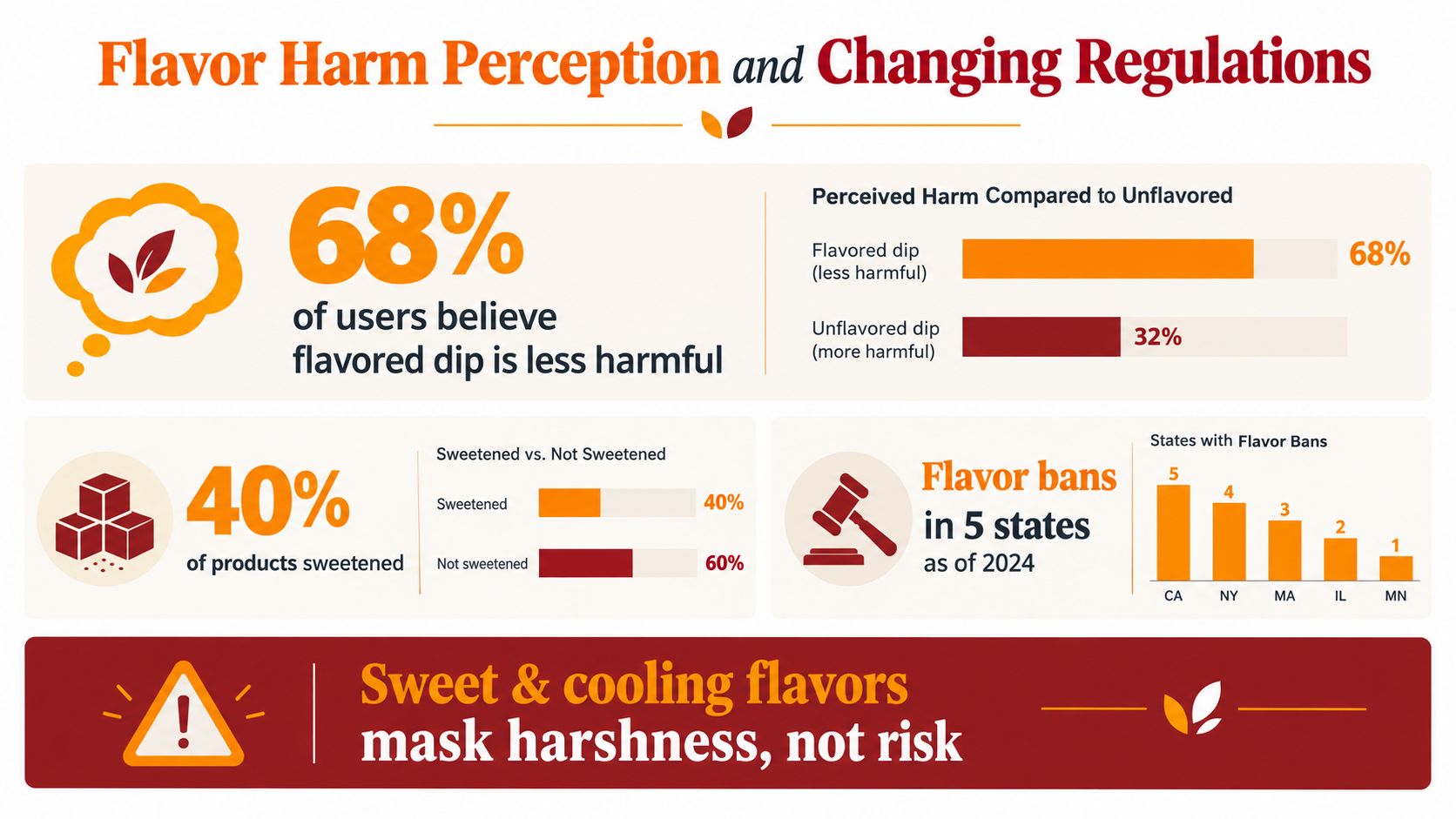
Infographic claims about harm perception can vary by survey and wording, so treat any single percentage as indicative rather than definitive. The reliable takeaway is qualitative: a smoother sensory experience can create a misleading impression of lower risk. Flavor changes what the mouth notices first, not what nicotine and tobacco do in the body.
Why regulators focus on flavor
Public-health surveillance links flavored products with youth smokeless tobacco use. In the 2021 National Youth Tobacco Survey, 72.1% of current high school smokeless tobacco users reported using flavored products, according to this public-health summary of flavored tobacco evidence. That finding helps explain why regulators examine flavor systems, product names, and formats rather than treating flavor as a cosmetic detail.
Rules differ across jurisdictions. California prohibits the sale of flavored tobacco products with limited carve-outs, while 11 states introduced bills in 2025 to restrict flavored tobacco or vapor products, as reported in this policy tracking document. Availability can therefore change by state, product category, and how a rule is interpreted.
Restrictions may change product design
Manufacturers may respond through reformulation, new naming, or tobacco-free formats. A familiar wintergreen or mint cue might remain, while fruit and fusion profiles receive greater scrutiny in some markets. According to the same policy analysis, flavored smokeless tobacco use among California youth users declined from 93.1% in 2022 to 83.1% in 2023, while remaining high.
The following overview walks through how flavor bans have reshaped smokeless tobacco shelves.
Flavor can shape appeal and harm perception without making tobacco safe. Anyone checking availability should confirm current state and local rules instead of relying on an old product list. That distinction also matters when comparing familiar dip flavors with nicotine-free pouches: a pouch may reproduce cooling, sweetness, or mouthfeel, but it does not reproduce tobacco's chemistry or nicotine's effects.
Nicotine Free Pouch Alternatives That Mimic Familiar Flavors
A person who wants to leave dip may miss several things at once: nicotine, the pouch position, the cooling sensation, the routine, or the small pause built into a workday. A nicotine-free pouch addresses only some of those needs, but flavor matching can make the behavioral transition less abrupt.
Match the familiar profile
Flavor mapping works best when the goal is stated clearly:
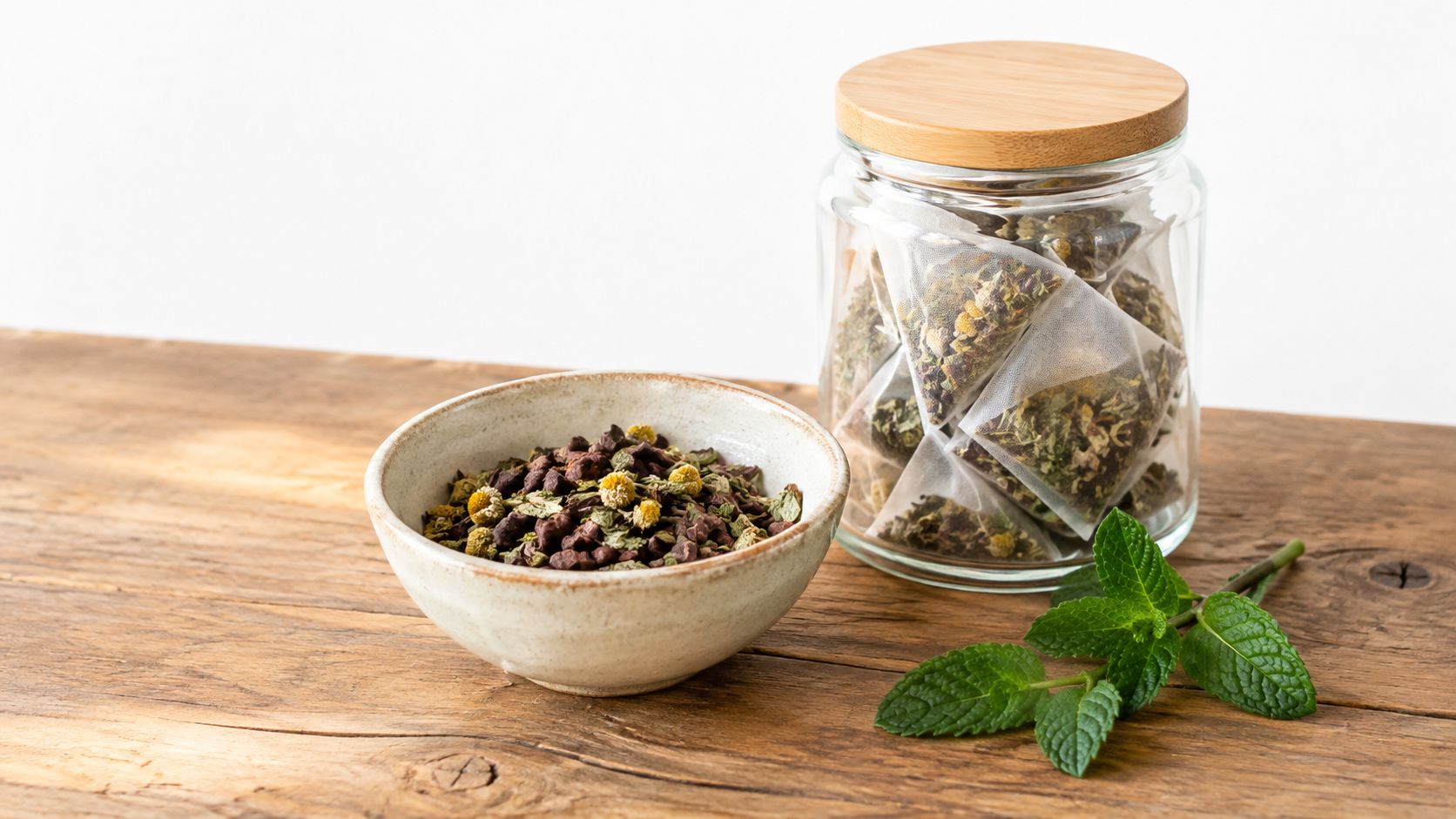
- Wintergreen user: A wintergreen nicotine-free pouch can preserve the familiar cooling and herbal association without tobacco or nicotine.
- Mint user: Arctic or clean mint profiles may reproduce freshness and oral cooling, though they won't duplicate tobacco's chemistry.
- Fruit user: Blood orange or berry profiles can provide citrus brightness or sweet fruit aroma without relying on tobacco bitterness.
- Straight user: An herbal or tea-based pouch may better preserve the earthy, plant-based ritual than a candy-like flavor.
These alternatives should be described accurately. Nicotine-free doesn't mean chemically identical to dip, and it won't reproduce nicotine's reinforcing effect. The purpose is to retain selected sensory and behavioral cues while removing nicotine and tobacco.
Timing can matter more than flavor
A structured pouch routine can separate daytime stimulation from evening relaxation. Morning users may prefer a citrus profile paired with an activation-focused formula. During work or a long shift, mint or wintergreen can provide a familiar oral cue. At night, a berry profile may fit a wind-down routine better than a cooling stimulant-associated flavor.
The non-tobacco pouch guide offers a useful way to think about the format without assuming that every user wants the same effect. The central decision is whether the pouch is being used for focus, ritual, freshness, or recovery.
What to check before switching
Read the ingredient panel and confirm that the product is nicotine-free and tobacco-free. Sugar-free labeling may also matter for users who want to avoid a sweet coating, but flavor intensity still depends on aroma compounds, moisture, and the base material.
Someone with strong nicotine dependence may experience withdrawal when switching directly to a nicotine-free option. A pharmacist or clinician can help create a cessation plan, especially if cravings, mood changes, or concentration problems become difficult to manage.
Choosing Your Next Step With Flavor and Focus in Mind
A better decision starts by separating three questions. What flavor does the user prefer? What physical sensation does the user want? What substance does the user want to keep or remove? Those questions prevent a common mistake, choosing a pouch based on wintergreen or mint alone and assuming the experience will match dip.
Flavor preference can be narrowed into a practical sequence:
- Identify the dominant cue. Is the appeal cooling, fruit sweetness, tobacco earthiness, or the pouch ritual itself?
- Describe the mouthfeel. Does the user prefer a moist, dense, gentle, sharp, or lingering sensation?
- Treat smoothness cautiously. A cooler or sweeter product may feel less harsh without being less addictive or less harmful.
- Check the market. Flavor availability and restrictions vary by location, so current local rules matter.
- Choose the intended endpoint. A tobacco-free nicotine product maintains nicotine, while a nicotine-free pouch removes the addictive ingredient but may not satisfy chemical cravings.
The chemistry adds one more reason to avoid judging products by taste alone. pH, moisture, humectants, cut, and flavor work together, so two products with the same label can produce different sensations. Readers who want to reduce nicotine should evaluate the switch by the habit it preserves, not solely by whether the first flavor seems familiar.
A useful test: If the goal is nicotine cessation, choose an alternative that supports the ritual without quietly recreating the nicotine cycle.
Nicotine-free pouches may suit people who want a discreet oral routine during work, travel, long shifts, or focused tasks. Others may need evidence-based cessation support for withdrawal rather than a flavor substitution. The right next step depends on whether the priority is sensory continuity, nicotine reduction, or complete nicotine cessation.
For readers ready to replace familiar dip tobacco flavors with a nicotine-free routine, Optimal Native offers sugar-free, nicotine-free nootropic pouches in Blood Orange, Arctic Mint, Wintergreen, and Midnight Berry. Explore the formulas by intended use, from daytime energy and focus to evening wind-down, and choose the flavor and routine that best fit the next stage.