

Problem Solving Focus: Practical Strategies That Work
Most advice about problem solving focus starts with willpower. It tells people to try harder, block distractions, or drink another coffee. That approach misses the true failure point. Focus usually breaks because the work session has been designed around interruptions, unclear goals, poor transitions, and inadequate recovery.
Problem solving is an attention-management task before it becomes an intelligence task. The right environment reduces incoming noise, a defined target gives attention somewhere to go, and deliberate timing prevents every interruption from forcing a full mental restart. The practical question isn't, “How can someone force concentration?” It's, “What structure makes concentration easier to maintain?”
Table of Contents
- Why Problem Solving Focus Is an Attention Architecture Problem
- The Prep Ritual That Primes Your Attention
- Framing the Problem Before You Start
- Session Timing and Attention Management
- Quick Cognitive Drills When Focus Drifts
- Recovery Practices That Sharpen the Next Session
- Putting It All Together in a Daily Protocol
Why Problem Solving Focus Is an Attention Architecture Problem
Willpower is a poor foundation for sustained problem solving. A session can fail before the first meaningful decision because notifications compete for attention, open tabs preserve unfinished contexts, and vague objectives force the mind to define the task while solving it. Discipline cannot compensate for a workspace and schedule that keep reopening competing demands.
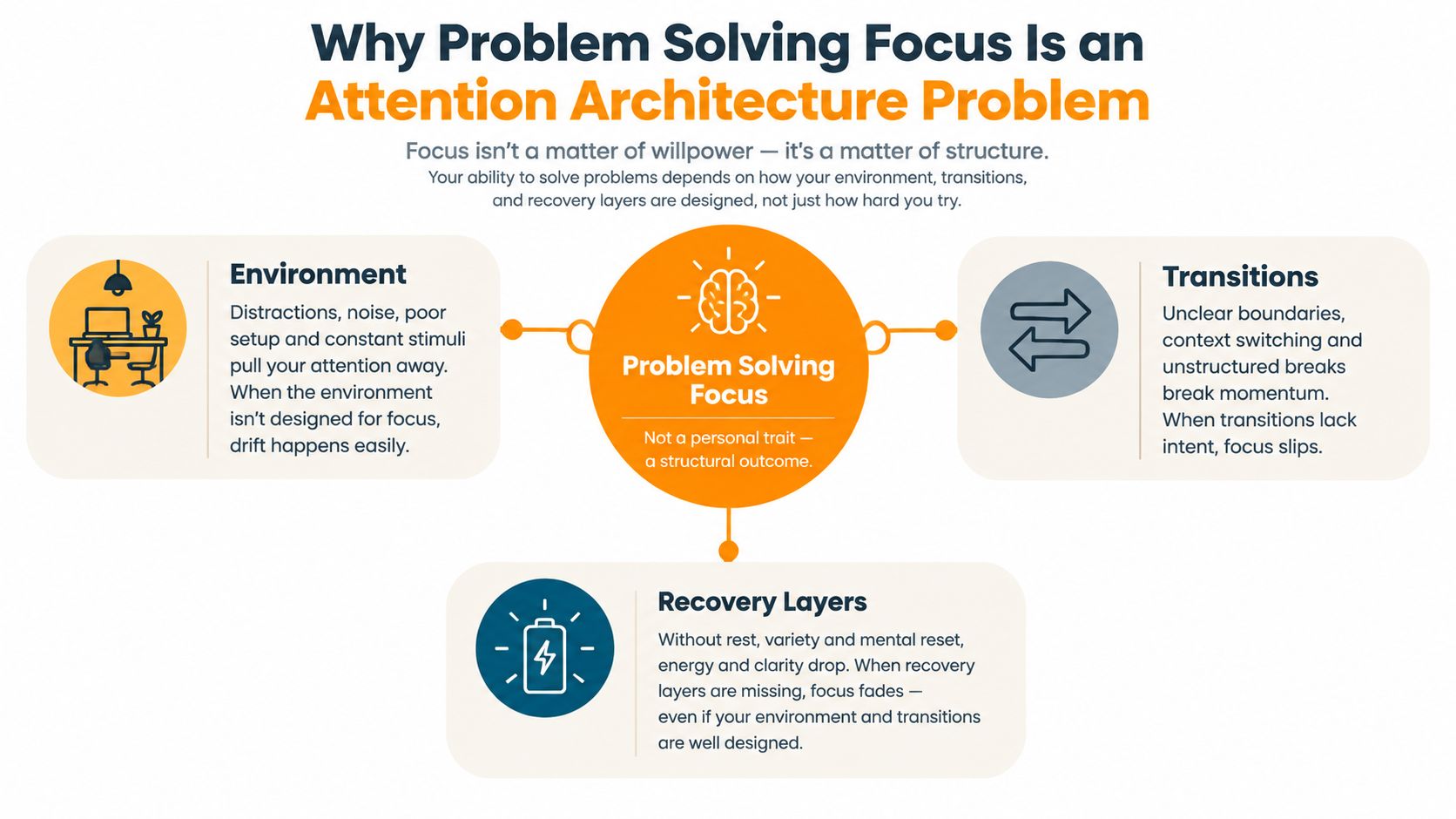
That makes problem solving focus an attention architecture problem. A workable session has three interacting layers: the environment controls incoming cues, transitions determine how often working memory must reload the problem, and recovery determines whether the next session begins with usable capacity. Research on task switching finds that alternating between tasks leads to slower, generally more error-prone responses immediately afterward. Preparation may reduce the cost, but it does not erase it, so uninterrupted blocks remain more dependable than constant switching (task-switching research from Duke University).
The three layers that hold attention
Environment controls the input channel. A phone on the desk, email previews, nearby conversation, and unrelated browser tabs create competing cues. Removing them reduces the filtering work required from the brain. The goal is not aesthetic minimalism. It is fewer possible next actions while the active problem remains in working memory.
Transitions control the cost of changing context. A single-problem workflow keeps the working model available. Switching tasks forces the solver to reconstruct assumptions, constraints, and the last useful line of reasoning, even if the interruption seemed brief.
Recovery layers determine whether later sessions start with usable cognitive capacity. Sleep disruption, occupational stress, and shift work have been associated with poorer executive functioning, psychomotor vigilance, cognitive control, visual attention, processing speed, and working memory in the systematic review and meta-analysis summarized by the BMJ occupational health review.
Practical rule: Treat weak willpower as a possible sign of weak session design. Rebuild the structure before demanding more effort.
Once the architecture is sound, the method becomes the next lever. Comparing root-cause analysis, structured ideation, and decision frameworks through problem solving methods that work is more useful than adding another concentration hack. The same principle guides executive function support: reduce avoidable demands before adding technique. A timed nootropic pouch protocol can fit into that structure as one controlled input, but it cannot replace preparation, deliberate transitions, or recovery.
The Prep Ritual That Primes Your Attention
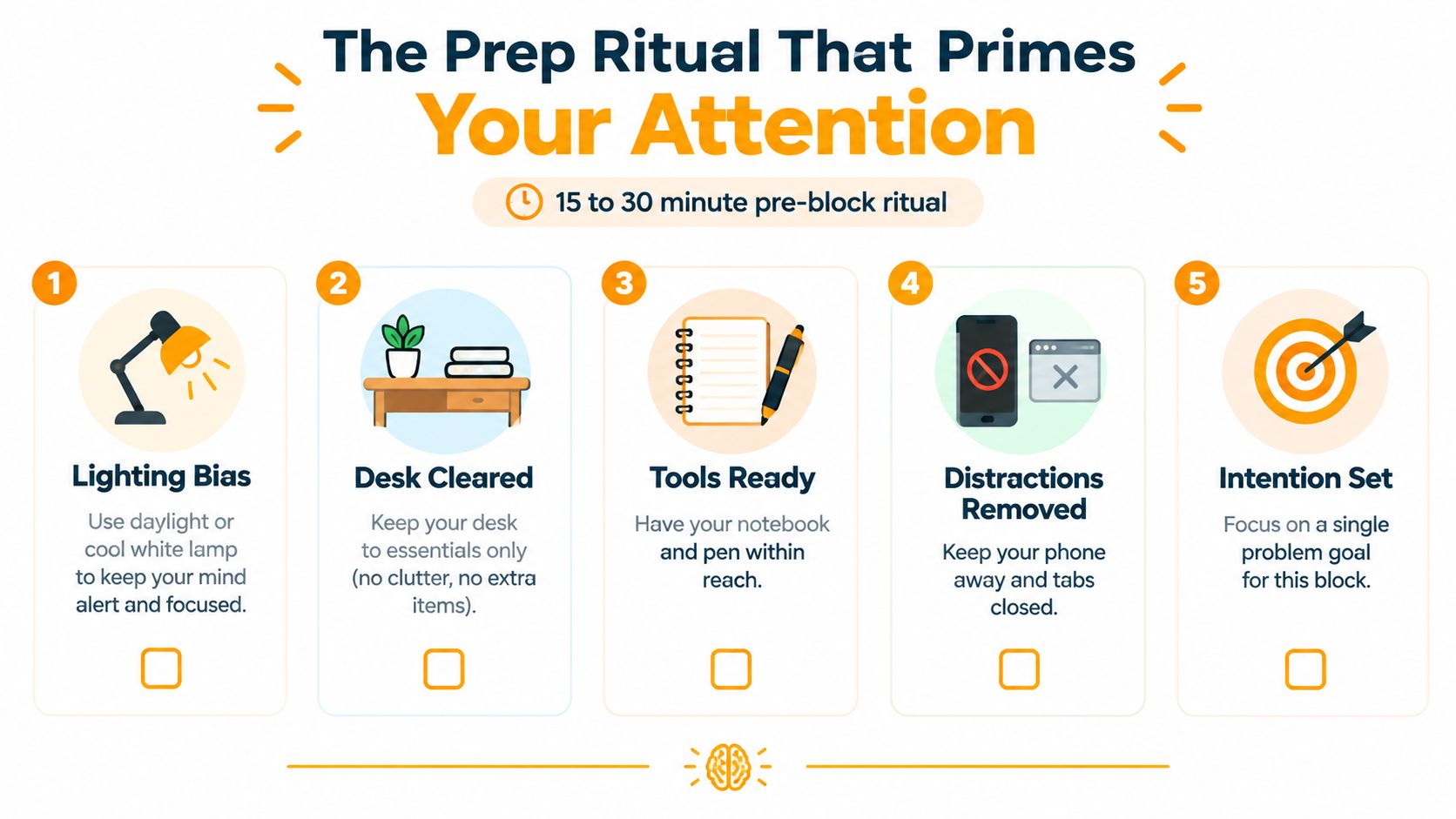
A problem-solving block should begin before the timer starts. A 15 to 30 minute preparation window gives the brain a consistent transition from open-ended intake to deliberate reasoning. The routine doesn't need to be elaborate, but it must remove decisions that would otherwise compete with the first minutes of the session.
Build the physical setup first
Use daylight where possible, or choose a cool-white lamp if the room is dim. Clear the desk until only the tools for the current problem remain, ideally one screen, a notebook, and a pen. Put the phone in another room rather than relying on silent mode, then close email, Slack, news pages, and every tab that invites “just a glance.”
The point isn't aesthetic minimalism. Each visible object can cue a different task. A cleared workspace narrows the number of possible next actions, which makes it easier to keep the active problem in working memory.
Hydration should be handled before the block, not used as a reason to wander away from it. A small protein-forward snack can help when hunger is competing with concentration, while a heavy meal may create a different kind of drag. The useful standard is simple: arrive at the session physically steady, not distracted by thirst, hunger, or digestive discomfort.
Lower the baseline noise
A 90-second breathing cycle can help reduce unnecessary arousal before demanding reasoning. The breathing pattern should be comfortable and controlled, with the exhale allowed to lengthen slightly without forcing the lungs. This isn't a promise of instant calm. It's a short signal that tells the body the session has a defined beginning.
A practical sequence looks like this:
- Set the light: Daylight or cool white, with glare reduced.
- Clear the desk: Keep only the current problem's materials.
- Remove inputs: Phone away, browser closed, communication apps paused.
- Prepare the body: Drink water, eat lightly if needed, complete the breathing cycle.
- Write the cue: State the single problem, desired output, and session boundary.
The final cue matters more than the ritual's appearance. A written sentence such as “produce a decision matrix for the vendor choice” gives the mind a clean mode switch. A consistent morning setup can also be adapted from the principles in this guide to a morning routine for energy optimization.
Framing the Problem Before You Start
A fuzzy problem consumes attention because it makes the solver define the work while performing it. “Improve onboarding” sounds actionable, but it doesn't specify what improvement means, which part of onboarding matters, or what evidence would count as progress. A better frame turns the session into a bounded reasoning task.
Write one sentence containing the problem and the intended output. Then name the artifact that should exist when the block ends. That artifact might be a diagram, a function signature, a decision matrix, a written recommendation, or a prioritized list of hypotheses.
Goal specificity changes where attention goes. Research summarized in Memory & Cognition found that non-specific goals direct attention toward local relations between successive problem states, while specific goals direct attention toward relationships between the current state and the target state (the goal-specificity research summary). Both forms of attention matter, but they shouldn't be left to chance.
A practical framing example
Take “improve onboarding” and rewrite it as: “By the end of this session, produce a decision matrix comparing the current onboarding flow with three possible friction-reduction changes.” The scope boundary excludes pricing, acquisition, product positioning, and long-term retention. The stop condition is reached when the matrix contains criteria, evidence gaps, and a recommended next test.
A 90-minute budget can be assigned to that session, with the first portion used to map the current flow, the middle portion used to compare alternatives, and the final portion used to record the recommendation and unresolved questions. The number is a planning boundary, not a guarantee of completion. If the problem expands, the solver records the adjacent issue instead of absorbing it.
| Dimension | Local Attention | Target-State Attention |
|---|---|---|
| Primary question | What follows from the current step? | What must be true at the end? |
| Useful for | Debugging a branch, checking logic, verifying evidence | Defining success, selecting scope, judging progress |
| Main risk | Getting trapped in intermediate detail | Ignoring useful local contradictions |
| Deliberate cue | “What does this step reveal?” | “Does this move toward the target artifact?” |
A solver can alternate deliberately between both modes. Broader prioritization guidance, including proven ways to stop drowning in tasks, can help decide which problem deserves a protected block rather than allowing every open loop to compete for entry.
Session Timing and Attention Management
A long block is not automatically a productive block. Session length should match the problem's complexity, uncertainty, and working-memory demands. Familiar analysis may support a longer uninterrupted stretch. An ambiguous systems problem often benefits from shorter intervals and explicit checkpoints.
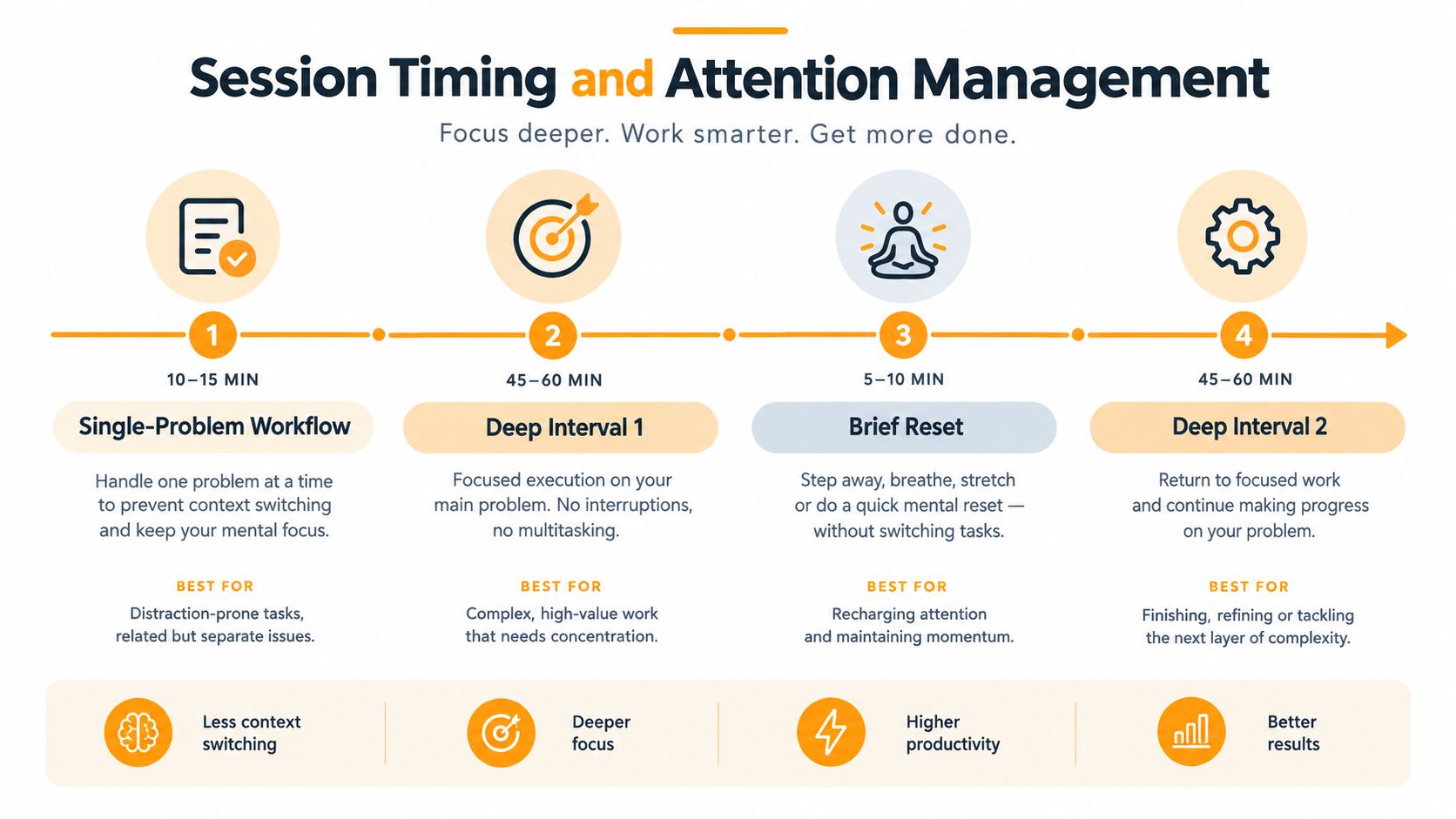
Use a single-problem workflow by default. Opening a message thread during debugging forces the brain to preserve one model while loading another. As noted earlier, preparation can reduce the switch penalty, but it does not remove the slower, more error-prone recovery that follows a task change. Keep incoming work outside the block unless it directly changes the problem being solved.
Match intervals to the work
Begin with a short orientation and execution interval. Then reset without changing tasks. Stand, look away from the screen, or write the problem's current state. Do not turn the reset into inbox time.
A practical sequence is:
- Start ritual: Re-read the one-sentence goal and target artifact.
- Deep interval: Work only on the named problem.
- Checkpoint: Decide whether the current path is producing evidence or repeating effort.
- Second interval: Continue, change the method, or document the next experiment.
- Hard stop: Capture unfinished reasoning and end cleanly.
The checkpoint separates productive difficulty from depletion. Productive difficulty creates new constraints, testable hypotheses, or clearer distinctions. Busy attention creates activity without changing the working model.
Protect the second peak
Place the hardest problem earlier in the available cognitive window, before accumulated decisions have reduced attention quality. Administrative work can follow, but inserting it into the middle of difficult reasoning weakens both activities.
Timing also matters for tools used during work. A timed pouch protocol should be treated as a planned input before attention has already deteriorated, not as permission to extend a failing session. The review of the caffeine and L-theanine evidence describes modest, acute, task-specific effects, including attention-switching and digit-vigilance accuracy. These small effects offer no universal productivity guarantee, so the protocol should support a well-designed session rather than replace one.
Quick Cognitive Drills When Focus Drifts
Focus drift doesn't always require ending the session. The correct drill depends on the failure mode. Visual fatigue, anxious arousal, and repetitive reasoning loops feel similar from the desk, but they need different interventions.
During a debugging block, a developer may notice that the same failing branch has been inspected repeatedly without a new hypothesis. The first move is a 60-second external gaze shift, looking across the room or through a window rather than at another screen. This interrupts the visual loop without importing a new task.
If the branch still feels sticky, the developer rewrites the problem in plain language: “The function receives the expected input, but the state changes before the validation step.” That reframing externalizes the current model and often exposes the missing assumption.
Match the drill to the drift
- Visual fatigue: Look at a distant object for about a minute, then return to the exact line of reasoning.
- Branch fixation: Restate the problem, known facts, and unresolved question in fresh language.
- Working-memory overload: Write the current model on paper, including what has already been ruled out.
- Anxiety spike: Use comfortable box breathing for 90 seconds, then reread the target condition.
- Diffuse attention: Count backward in 7s from 100, or briefly widen peripheral awareness before narrowing back to the task.
The arithmetic drill isn't a productivity trick. It gives attention a constrained sequence, which can help break an unstructured mental loop. It also shouldn't be used when the person is already severely fatigued, because adding effort may obscure the need for recovery.
A reset should preserve the problem, not replace it with a different source of stimulation.
In the debugging example, the gaze shift followed by micro-writing can restore the working model without opening a new application. If the developer returns with a clear hypothesis, the session continues. If the same loop resumes, the right choice is to stop, record the next test, and recover rather than forcing more minutes out of depleted attention.
Recovery Practices That Sharpen the Next Session
The next problem-solving session begins before you sit down again. Without a clear shutdown, unfinished reasoning keeps competing for attention during meals, conversations, and sleep. A short closing routine gives the mind a defined place for incomplete work.
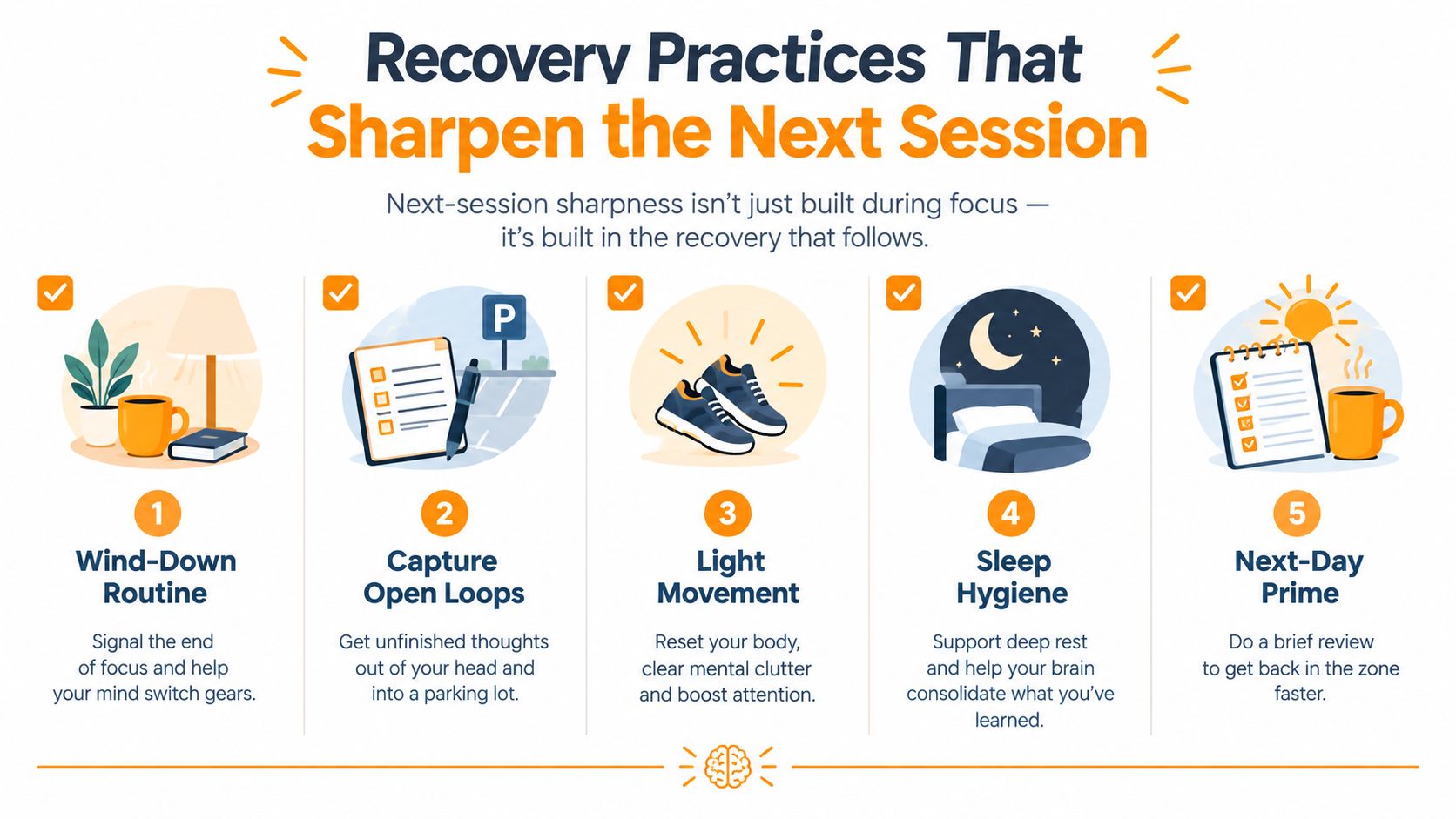
Write a parking-lot note with the current state, the next physical action, and the unanswered question. “Continue debugging tomorrow” leaves too much reconstruction. “Run the test with the state transition logged, then compare the validation order” creates a usable re-entry point.
Close the cognitive loop
Use a wind-down sequence that reduces cognitive carryover:
- Capture open loops: Record decisions, uncertainties, and the next action.
- Mark the boundary: Close the work surface and change location if possible.
- Move lightly: Walk or do gentle mobility instead of adding another demanding input.
- Reduce stimulation: Shift to quieter lighting and less challenging content.
- Prime tomorrow: Review only the first action, not the whole unresolved problem.
Sleep supports the conditions required for reasoning. That matters more when work involves irregular schedules, sustained pressure, or repeated transitions between shifts. As noted earlier, occupational health evidence connects shift work and occupational stress with poorer performance in executive functioning, working memory, visual attention, and cognitive control. For frontline workers, “stay focused” is incomplete advice when the work structure repeatedly disrupts sleep and recovery.
Evening inputs should serve sleep rather than rescue a weak daytime routine. Schedule caffeine and other stimulating products early enough that their effects do not compete with wind-down. A recovery-oriented product can fit into a timed routine, but it cannot correct chronic sleep debt, rotating shifts, or prolonged stress exposure.
For night workers, recovery may happen during daylight and require blackout conditions, consistent timing where possible, and a deliberate transition after the shift. Make the end of work visible through the same sequence each time. That boundary helps separate operational vigilance from the lower stimulation needed for recovery.
The objective is readiness for the next session, not squeezing more output from the current one. Capture the handoff, lower the input load, and let recovery do work that another stimulant or productivity ritual cannot.
Putting It All Together in a Daily Protocol
A workable daily protocol should be repeatable before it becomes optimized. The sequence below gives a practitioner a template for protecting problem solving focus without turning supplements, timers, or rituals into the main event.
Morning setup
Keep the wake time consistent when the schedule allows. Before the first demanding block, reserve a 15-minute preparation window for light, desk clearing, hydration, phone removal, and the written goal. The first block should contain one problem and one target artifact.
A default 90-minute block can work for a defined analysis or creation task, but the duration should be shortened when the problem is unusually ambiguous or mentally expensive. Place one mid-block drill slot on the schedule, even if it isn't always needed. The slot provides a planned reset instead of inviting an improvised scroll through messages.
Daytime sequencing
Assign the hardest reasoning to the freshest suitable period, then schedule meetings, administration, or lower-load execution around it. At the start of every block, rewrite the scope boundary in one line. This prevents a new message or adjacent question from changing the assignment.
A timed nootropic pouch format can be one scheduled input within this structure, rather than the centerpiece. Optimal Native offers nicotine-free oral pouches organized around morning energy, daytime focus, and evening recovery, including caffeine and L-theanine in daytime formulas and a separate evening formula with melatonin, L-theanine, magnesium, and apigenin. The caffeine and L-theanine evidence remains modest and task-specific, so the product should be evaluated as a timing tool inside a sound routine, not as a replacement for framing, uninterrupted work, or sleep.
Executives and shift-based professionals can adapt the sequence to changing duty windows. Broader insights for UAE executives may help leaders think about productivity as an operating system rather than a collection of isolated tricks. Guidance on improving mental clarity follows the same practical logic: reduce cognitive noise, define the next action, and protect recovery.
Evening close and review
After the final block, capture open loops, record what changed in the problem model, and perform a clear shutdown. Over the following two weeks, track qualitative signals: how quickly the session entered useful reasoning, how often context switching occurred, whether the target artifact was produced, and how sharp the next session felt.
The protocol should change based on those observations. If the first block is strong but the second collapses, recovery or sequencing may be the constraint. If every block starts slowly, the framing or preparation ritual may need redesign. Better problem solving focus comes from treating attention as an engineered system, then refining that system against real work.
Optimal Native offers nicotine-free oral pouches for timed morning energy, daytime focus, and evening recovery routines. Visit Optimal Native to explore a structured option that can fit alongside clear problem framing, protected work blocks, and deliberate recovery.