

Shift Work Schedule Types and How to Make Them Work
UpdatedShift work involves approximately one-fifth of the workforce in Australia, the European Union member states, and the United States, the International Labour Organization reports. That share sits in hospitals, utilities, emergency services, transport, and logistics, not in a small specialty. A workable shift work schedule is the sequence of start times, shift lengths, and days off. Rotation direction can lower risk. It doesn't fix a roster that never leaves enough time to sleep.
Table of Contents
- Shift Work Schedule Types at a Glance
- How Rotation Direction Shifts Your Body Clock
- The Health Costs of Night and Rotating Work
- Roster Limits That Protect Recovery Time
- Sleep and Light Steps for Changing Shifts
- When Sleep Advice Falls Short and What Helps
- Choose Your Schedule and Test It for Two Weeks
Shift Work Schedule Types at a Glance
In 2024, 27% of U.S. employees had irregular work schedules, including 17% whose hours varied based on employer needs and 10% whose hours varied at their own request, according to the Federal Reserve Board. Among U.S. workers on non-daytime hours in 2024–2025, 37% said the schedule was required by the nature of the job, while 24% cited personal preference, the Bureau of Labor Statistics reports. Shift work grew as factories, hospitals, and utilities needed continuous coverage.
Read the table as a lookup, not a ranking. Each row is a pattern, a benefit, and the risk that usually shows up first.
| Schedule type | Typical pattern | Main benefit | Main risk |
|---|---|---|---|
| Fixed day | Same daytime hours every week | Most stable sleep rhythm | Limited coverage for night-time needs |
| Fixed night | Same night hours every week | Predictable sleep-wake routine once adapted | Hard to adapt; many workers struggle, so days off need a night routine |
| Forward rotation | Day, then evening, then night | Gives the body clock more time to delay sleep | Can still worsen sleepiness, as offshore crews have shown |
| Backward rotation | Night, then evening, then day | Returns the worker toward daytime hours in one cycle | Generally less favoured than forward rotation under AASM guidance |
| Rapid rotation | Pattern changes every few days | Caps how long anyone stays on one shift type | Repeated circadian disruption |
| 12-hour shifts | Two or three 12-hour duties in a row | Fewer commutes and longer rest blocks | Fatigue rises; recovery days are essential |
| 8-hour shifts | Five 8-hour shifts per week | Lower fatigue per shift | More commute days and handovers |
| 4x10 shifts | Four 10-hour shifts per week | Longer weekends | Long single days limit recovery |
| Irregular call | Shifts set by need, changing week to week | Flexible coverage | Hardest to plan sleep around |
Forward rotation moves day to evening to night. Backward rotation reverses that order, night to evening to day. People mix these up because both are called rotating. The direction is the order of the blocks, not how fast they change. A rapid roster can spin either way.
Teams that manage shifts with employee experience in mind treat the pattern as something staff have to live, not only a coverage grid.
A two-week roster audit
Pull the last 14 days of actual start and finish times.
- Count consecutive nights: Note the longest run, not the average.
- Note shift length: Mark 8, 10, and 12 hours separately.
- Check start-time movement: See whether starts march later, jump earlier, or change with no pattern.
The row that matches those three counts is the schedule you have, even if the posted name says something else.
How Rotation Direction Shifts Your Body Clock
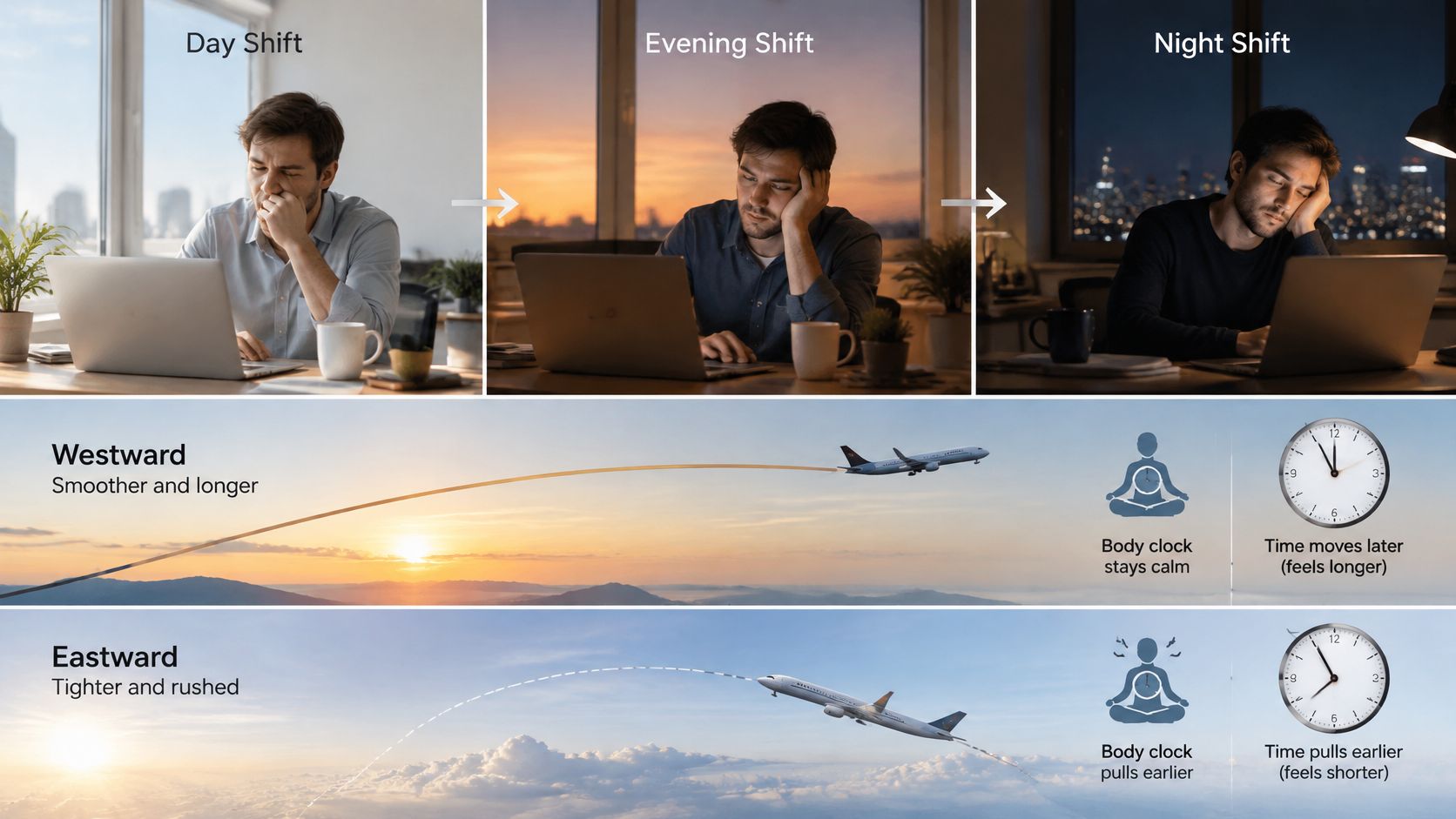
Flying west is easier than flying east. The body clock finds it easier to run late than to run early. The same bias shows up in a rotating shift work schedule.
What the clock is doing
Moving from day to evening to night gives the clock more room to push sleep and wake later. A night-to-day jump asks the clock to advance, which is the harder direction. That is a description of circadian timing, not proof that every forward roster feels better.
The American Academy of Sleep Medicine conditionally suggests clockwise rotation over counterclockwise rotation for adults with shift-work disorder, and the certainty of that evidence is very low. A Cochrane review found that forward rotation may reduce sleepiness at work, with uncertain effects on sleep duration and sleep quality. Forward rotation is a risk-reduction principle, not a guaranteed fix.
A 2025 naturalistic study of 70 offshore oil-and-gas workers found that forward rotations from day to night worsened perceived sleepiness, sleep efficiency, total sleep time, and reaction time compared with fixed day schedules, and workers adapted more slowly after the transition, as reported on PubMed. A theoretically friendlier direction can still fail the people on it.
Practical rule: Judge the roster by sleep onset and reaction time on that crew, not by the arrow on the diagram.
A nurse's rotation, checked on paper
Say a nurse moves through day, evening, and night blocks. Sleep onset slides later each cycle. That drift is the sign the direction is working with the clock.
Check it across one full rotation:
- Record sleep onset for every block, same definition each day (lights out, not the time you meant to sleep).
- Compare blocks in order. Later each cycle means the direction is helping.
- Flag a stall or an earlier onset. The roster needs a change, not a stricter bedtime speech.
Direction never replaces short night blocks, a ban on abrupt night-to-day reversals, or real days off after the last night. Those limits belong with recovery rules. This check only answers whether the arrow matches the clock.
A short walk-through of why the clock resists an early shift is here.
Bright light on the night shift, a fixed daytime sleep time, and less morning light can support adaptation. Timing and the individual response decide whether they help.
The Health Costs of Night and Rotating Work
Shift workers had 42% higher odds of sleep disturbance than non-shift workers in a meta-analysis of 22 cross-sectional studies involving 21,677 participants across eight countries.
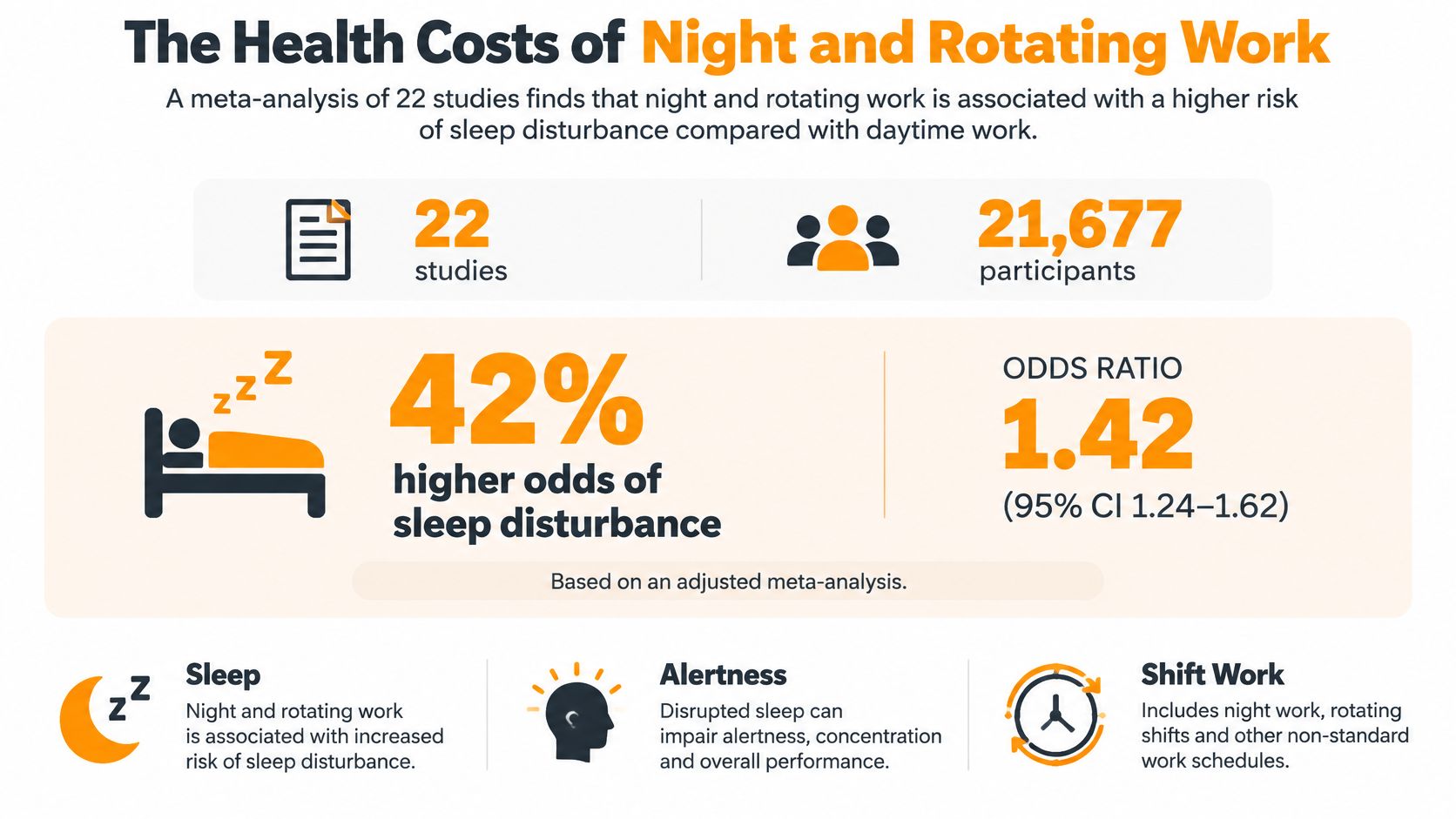
The BMC Public Health review reports an overall odds ratio of 1.42 (95% CI 1.24–1.62) for sleep disturbance; adjustment produced a similar estimate of 1.41. The association was 1.48 for rotating shifts and 1.77 for night shifts lasting eight hours or less. A review of systematic reviews published from 1999 through 2018 found about 10% excess diabetes risk among shift workers compared with day workers.
| Health outcome | Overall shift work effect | Rotating or night detail |
|---|---|---|
| Sleep disturbance | Odds ratio 1.42 (95% CI 1.24–1.62) | Rotating shifts 1.48; night shifts of 8 hours or less 1.77 |
| Diabetes | About 10% excess risk | Rotating 1.08–1.42; night work 1.09–1.19 |
| Cardiovascular disorders | The review reports an association | Associations reported for night work and rotating schedules |
| Gastrointestinal disorders | The review reports an association | Associations reported for night duty and rotation |
| Metabolic disorders | The review reports an association | Associations reported for night work and rotating schedules |
How to read an odds ratio
An odds ratio of 1.42 means 42% higher odds, not a 42% chance of developing a sleep problem. The confidence interval, 1.24–1.62, shows the range of estimates compatible with the studies. It does not predict what will happen to any one person.
Use the comparison that matches the schedule:
- Mostly rotating shifts: The sleep-disturbance estimate is 1.48. The reported diabetes range for rotating work is 1.08–1.42.
- Mostly night shifts: The sleep-disturbance estimate for night shifts of eight hours or less is 1.77. The reported diabetes range for night work is 1.09–1.19.
- Cardiovascular, gastrointestinal and metabolic disorders: The review reports associations with night and rotating work. Observational associations do not prove that a particular roster caused an illness.
The review also identified eight eligible systematic reviews and meta-analyses examining 16 health associations. These findings describe patterns across groups, not certainty for an individual. Their practical implication is to treat sleep timing and recovery as part of schedule planning, rather than as details to address after the roster is set.
Roster Limits That Protect Recovery Time
A roster can meet its weekly-hours target and still leave too little time to recover. Check each shift-to-shift gap, especially after nights or extended duties. A schedule is only workable if the time away from work leaves a realistic opportunity to sleep.
| Roster rule | Recommended limit | Why it matters |
|---|---|---|
| Off-duty interval | At least 10 consecutive hours per 24 hours | Leaves time for sleep, commuting, meals, and personal needs |
| Breaks during demanding duty | Short breaks every 1–2 hours | Helps manage fatigue during demanding work |
| Preferred shift pattern | Five 8-hour or four 10-hour shifts | Usually more tolerable than repeated 12-hour shifts |
| Rest after 12-hour shifts | Two rest days after three consecutive 12-hour shifts | Provides recovery time after extended duty |
| Night-shift block | About three shifts | Limits the length of a run of night shifts |
| Night-shift length | Eight hours or less where feasible | Limits circadian strain, though shorter shifts do not remove the risk |
| Recovery after night block | About three recuperation days | Allows time for sleep and circadian recovery |
NIOSH guidance recommends at least 10 consecutive hours off duty per 24 hours. That interval is a clock-time floor, not a guarantee of seven or eight hours of sleep: commuting, meals, and personal needs take up part of it. The guidance also favors brief breaks every one to two hours during demanding work and generally finds five 8-hour shifts or four 10-hour shifts more tolerable than repeated 12-hour shifts. If 12-hour duties remain in the roster, it recommends two rest days after three consecutive shifts.
AASM provider guidance describes night blocks of about three shifts, shifts of eight hours or less where feasible, and about three recuperation days after a night block. Treat these as risk-reduction principles, not a fix: shorter night shifts do not eliminate sleep disturbance, and recovery time still matters.
The gap that looks like 11 hours
A shift ends at 7:00 a.m., and the next starts at 6:00 p.m. The 11-hour interval meets the 10-hour off-duty rule on the clock. But two 45-minute commutes, a meal, and time to wind down leave under nine hours for sleep. The roster passes the clock-time test and fails the sleep-opportunity test.
HR teams using time and attendance best practices for HR can review recorded start and finish times to identify short turnarounds.
Audit every gap for two weeks
- List each interval between a shift's finish and the next shift's start.
- Subtract commuting time, meals, and wind-down time.
- Flag any remaining sleep opportunity under seven to eight hours.
A legal weekly total can still leave too little recovery after one shift. Set limits on consecutive long shifts, protect the off-duty interval, and schedule short breaks during demanding work.
Sleep and Light Steps for Changing Shifts
Light, sleep timing, and the roster work together like parts of a clock. These steps can support a shift work schedule that leaves a real sleep window; they cannot create one.
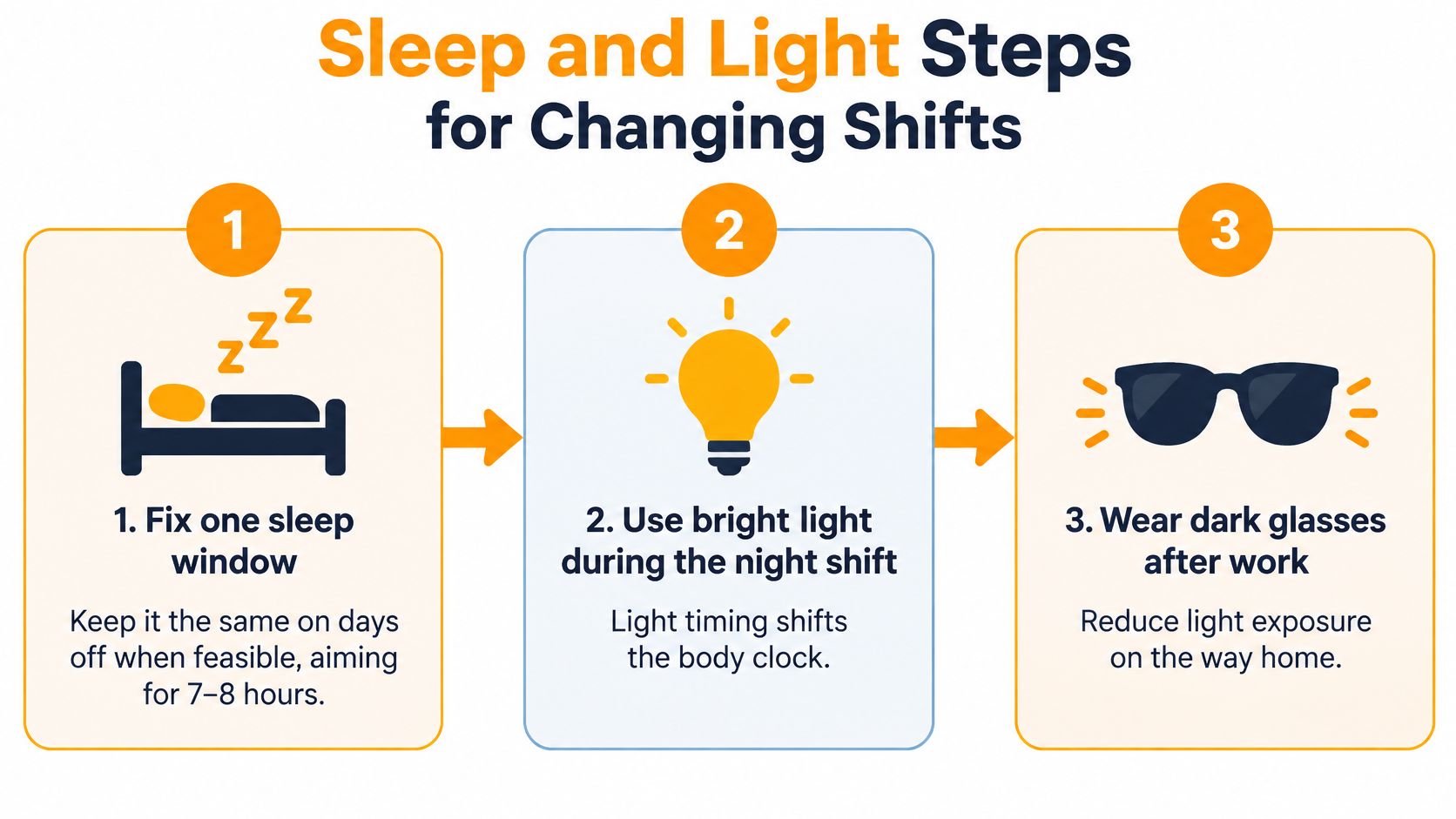
- Set a main sleep window. When feasible, keep the same sleep-work pattern on days off and allow 7–8 hours for the main sleep period. Sleeping in to catch up can push the next sleep block later. After a night shift, daytime sleep may be shorter, so protect the time available rather than assuming it will match a full night's sleep.
- Use bright light during the night shift. Light during the shift can push the body clock later. A dim work area followed by a bright phone screen on the way home sends mixed signals about when to be alert.
- Limit morning light on the commute home. Morning light can signal wakefulness, which may make it harder to sleep after a night shift. Sunglasses can reduce light exposure during the commute.
- Make the daytime room dark and quiet. Blackout coverings, a sleep mask, and a closed door can reduce interruptions. Even small amounts of daylight through the blinds may make the room feel less like a sleep space.
- Use melatonin only with a clinician's advice, and time it to the planned sleep period. The AASM clinical-practice guideline reports that studies commonly administered melatonin 30 minutes to two hours before a three- or four-hour planned sleep opportunity. The guideline conditionally suggests it for adults with insomnia or sleep disturbance after night work, while noting limited certainty in the evidence. This timing is tied to the sleep opportunity studied, not automatically to a longer sleep target or a fixed evening clock time.
- Stop caffeine well before planned sleep. A late coffee can make it harder to fall asleep after work, especially when the commute is long. A wind-down routine before bed can help mark the transition from work to rest.
- Drink water across the shift. Waiting until a headache starts can leave you reaching for caffeine when what you need is hydration. Recovery habits are also discussed in sleep and recovery for athletes, though that comparison does not establish what works for shift workers.
The three-night check
After three nights, ask whether you fall asleep within the planned window and whether you wake without an alarm. If either answer is no, first check whether the roster leaves enough time for sleep. Light and bedtime routines can support recovery, but they cannot replace lost time.
When Sleep Advice Falls Short and What Helps
Sleep education doesn't solve fatigue when the roster removes the chance to recover. A 2025 systematic review of qualitative evidence found that shift workers' sleep disturbance and fatigue aren't adequately solved by sleep education alone, and that support has to include self-regulation of behaviour, thoughts, and emotions, as indexed on PubMed. NIOSH-style schedule limits, fewer nights in a row, shorter evening and night shifts, and recovery days after long 10- or 12-hour runs, sit on the organisational side of that same problem.
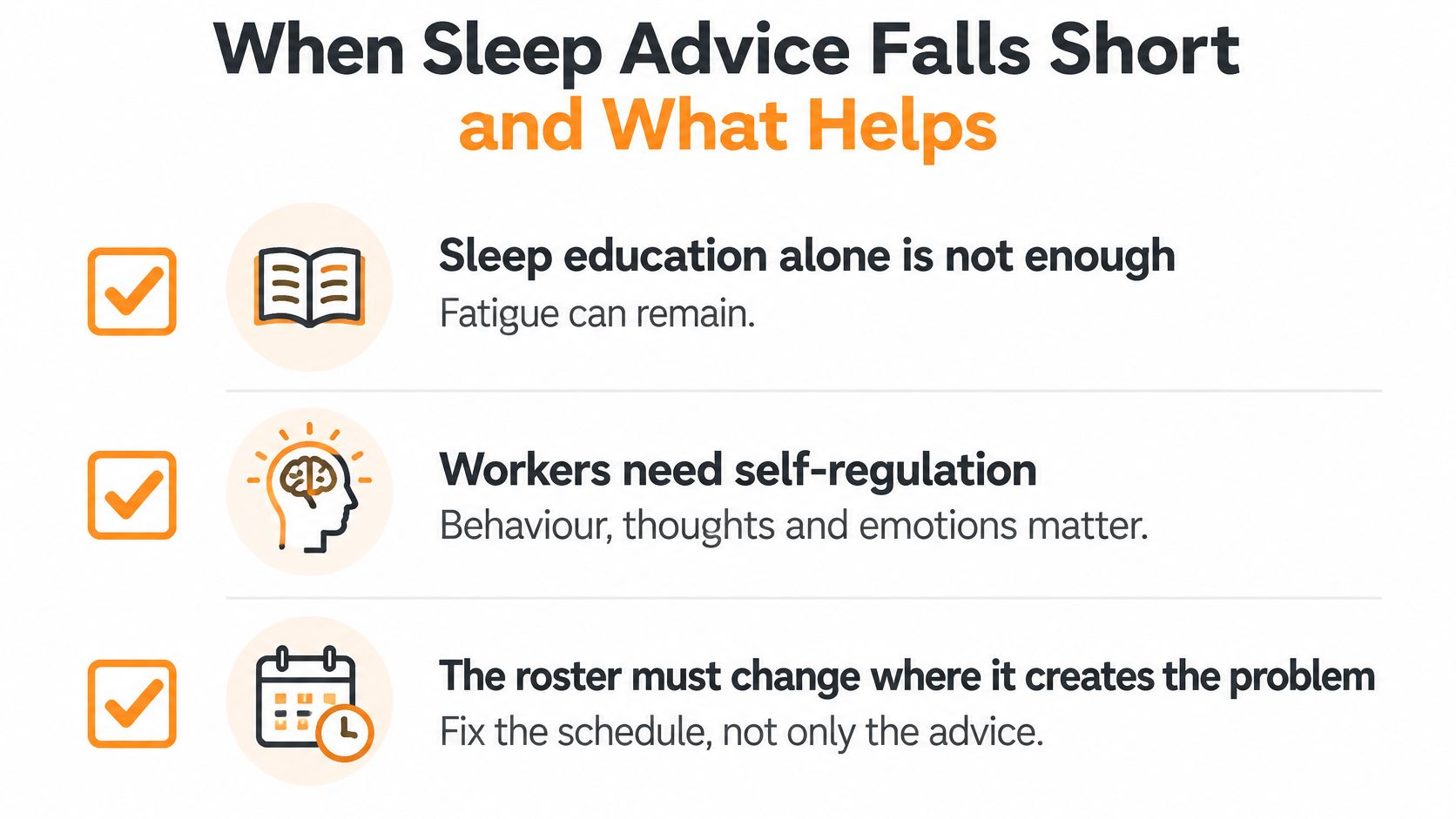
Personal countermeasures stay the light, nap, caffeine, hydration, and dark-room steps already listed. They support adherence. They can't replace hours the roster never gave back. Holding attention through a long night is closer to how to improve focus at work than to another sleep poster on the wall.
Organisational controls
- Protected breaks: Short and on the clock during demanding duty, not "when the board clears."
- Realistic staffing: Enough people that a break doesn't dump the load on one colleague.
- Shorter night shifts: Eight hours or less where the work allows.
- Minimal consecutive nights: A short block, then days off, not an open-ended run.
- A fatigue-risk reporting route: A named person and no punishment for saying you aren't fit to drive.
Red flags
Microsleeps, repeated near-misses, inability to stay awake while driving, and insomnia that continues past a fair trial of the sleep steps mean the roster changes first. Fatigue slows reaction time. The drive home is part of the hazard, not an afterthought.
A short script for a supervisor:
- Name the pattern. "Three nights in a row, finish at 5:00 a.m."
- Cite the red flag. "Near-miss on the drive home."
- Request one change. "Fewer nights in a row, or 10 hours before the next start."
When a red flag shows up, change the roster first. Sleep steps come second.
Choose Your Schedule and Test It for Two Weeks
Choose among the rosters your employer can offer, then compare them by recovery time: the gap between shifts, the length of night blocks, and the days available to recuperate. If the roster can change, consider forward rotation, fixed days, or 8-hour shifts. Fixed nights require a night-oriented routine on days off, while irregular on-call work is harder to assess because start times keep changing.
A routine can support a roster, but it cannot replace recovery time or make an unsafe schedule safe. Optimal Native's labeled schedule follows clock time: Morning Energy from 6:00 to 10:00, Daily Flow from 10:00 to 17:00, and Evening Relax from 17:00 to 22:00. Follow the product labels rather than shifting those windows to match a changing shift. Keep timing consistent, hydrate, and evaluate the protocol over 7–14 days. For caffeine timing, see this guide to preventing a caffeine crash.
The fortnight test
For 14 days, keep your routine steady and log sleep onset, wake time, alertness on the commute, and any red flags.
A schedule is working only if you can maintain a stable sleep window most days, avoid drowsy driving, and sustain performance across shifts rather than having one good day followed by a collapse.
If any of those conditions fail, address the roster first. Review the off-duty gap, night-block length, and recuperation days before changing your routine. Write down the current shift start times and lengths, match the pattern to the schedule-type table, then arrange a supervisor conversation using the three-line script.
Optimal Native's three nicotine-free pouches follow a clock-time schedule: Morning Energy from 6:00 to 10:00, Daily Flow from 10:00 to 17:00, and Evening Relax from 17:00 to 22:00. A timed routine cannot replace recovery time or a safe roster. Visit Optimal Native to see the formulas.